Khadim Hussain
March, 2026
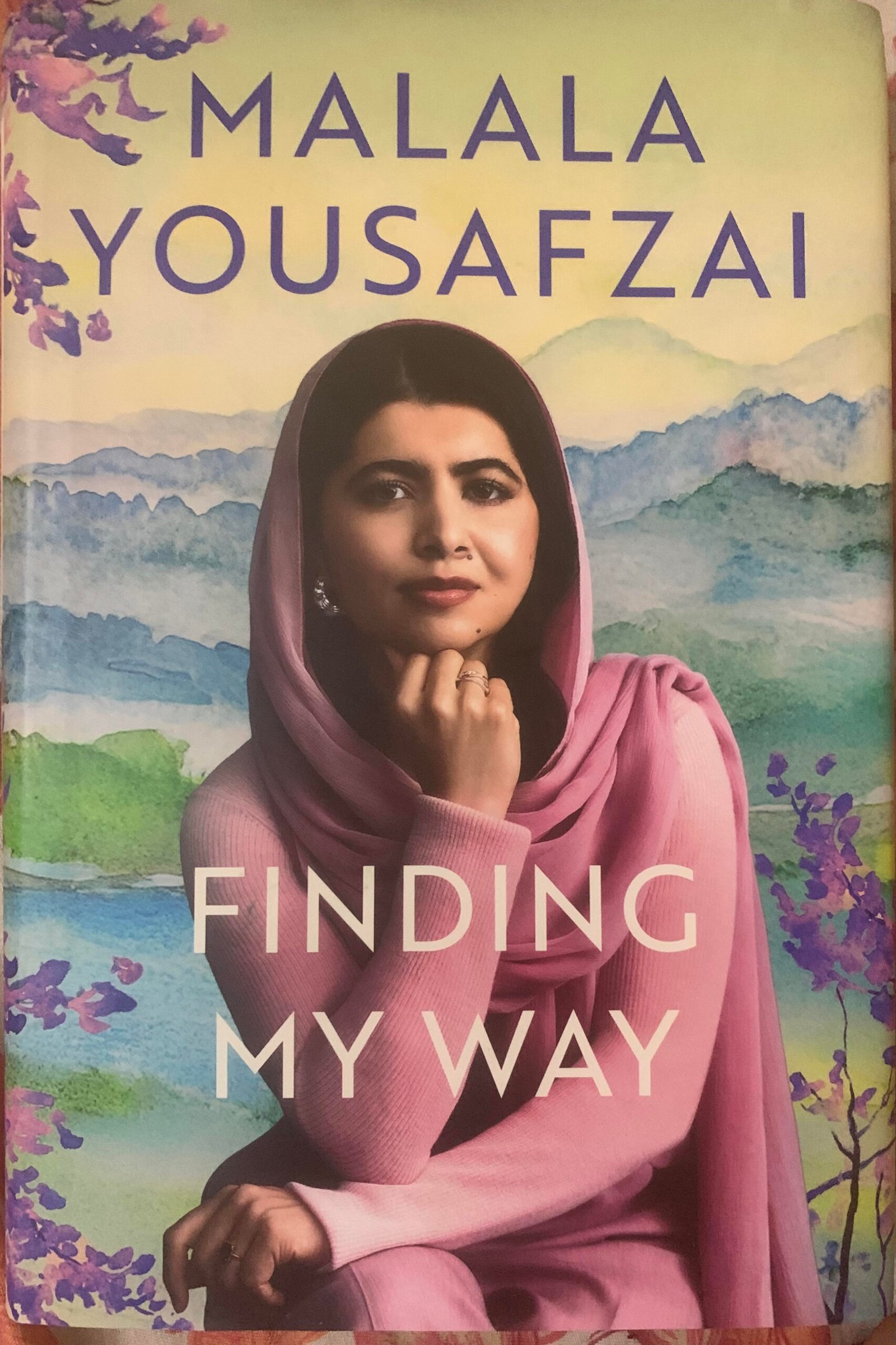
A girl raised her voice against extremist and fanatic violence that had silenced almost all human voices in the serene beautiful valley of Swat when she was only 11 years old. Her voice had become so influential at the age of 15 that the Taliban shot her point blank to silence her voice (responsibility for the attack was later taken by spokesperson of the Tehrik-i-Taliban Pakistan (TTP)). Her courage of standing up for peace became globally so remarkable and outstanding that she became the youngest Nobel Peace Laureate at the age of 17. The girl—now in her mid-twenties—has turned out to be one of the most phenomenal activists for gender equality, and one of the loudest voices for education of marginalised and subaltern girls on global level. She is none other than Malala Yousafzai, the co-founder of Malala Fund, and a designated United Nations Messenger of Peace. Malala Yousafzai embarks on a journey of finding her way—in a sense searching for discovering her Self and looking for Truth as Sidharta Gautama Budha would call it—in her new book Finding My Way, published by Simon & Schuster in 2025.
Malala Yousafzai in her Finding My Way appears to have navigated several themes ranging from of her thrilling educational experience at Lady Margaret Hall College of Oxford University, her panic attacks and post traumatic disorder, her feelings of loneliness, her media trial, her friendships, her yearning for love, her vacillating emotions about marrying the love of her life, to her work at the Malala Fund, her work for girls education in the marginalised countries, and her angst at the taking over of Kabul by Taliban. Beneath the apparent text of this profoundly interesting and substantial recent book by Malala Yousafzai, one may read her endeavour to peel off layers after layers that had wrapped the deeper corners of her consciousness over all these years. Like an adept surgeon, Malala Yousafzai in this book uncovers and then dissects the deeper subtexts that run through the whole body of the book with the tool of her peculiar captivating diction which has now become her distinct style of writing.
Malala Yousafzai knows quite well which end of the tangled threads to pick, and strives deftly like a consummated artist to disentangle the knots entwined in her Self over almost a decade. Undaunted by the pain that this digging into the Self entails, she remembers that “before I understood what was happening, I was thrust into an unfamiliar world—crossing the globe to give speeches and pose for photos spending most of my time with adults. Backstage at big events, one of them would spin me around by the shoulders and cry, ‘High Energy, Malala!’ (Yousafzai, 2025: 7). She was aware even at that tender age what it meant when people asked her “what do you remember about the shooting?” Naturally, it pained her to feel “as if the worst thing happened to me was the most interesting part of my life. It made me feel like a butterfly with a straight pin through its heart, forever trapped under a dusty glass. The living girl in front of them was not as captivating as the one on the school bus, a young dreamer about to die” (Ibid).
Malala Yousafzai later came to a painful realisation that the shooting of a daring young dreamer girl might have been captivating for some, but for many the attack was staged. This amounted to a second shooting, a second assault on her life. Although the spokesperson of the Taliban issued a statement claiming the attack on her life. Malala Yousafzai was attacked on October 9 2012 and on October 10 2012 one of the few credible news outlets in Pakistan, Dawn, reported that “the banned militant organisation Tehrik-i-Taliban Pakistan (TTP), which claimed responsibility of shooting 14-year-old peace activist Malala Yousafzai in the head, issued a statement Wednesday, using Islamic Shariah to defend the attack. In the statement sent out by TTP spokesman Ehsanullah Ehsan from an undisclosed location, the banned outfit said that although they do not believe in attacking women, “whom so ever leads a campaign against Islam and Shariah is ordered to be killed by Shariah” (Dawn, 2012).
A year after the attack on Malala in July 2013, a Taliban commander Adnan Rashid, according to The Guardian, wrote an open letter describing the circumstances that convinced the Taliban to carry out an attempt on Malala’s life. The report says that “a senior member of the Pakistani Taliban has written an open letter to Malala Yousafzai – the teenager shot in the head as she rode home on a school bus – expressing regret that he didn’t warn her before the attack, but claiming that she was targeted for maligning the insurgents. Adnan Rasheed did not apologise for the attack, which left Malala gravely wounded, but said he found it shocking” (The Guardian, 2013). The doctors who treated her in Pakistan and the UK were interviewed frequently on electronic media “but none of the evidence made a dent in the growing masses who believed it was all set-up…the constant, widespread denial of what happened to me was a second assault, leaving wounds that wouldn’t heal” (Yousafzai, 2025: 72).
Probably part of Malala’s Self had always remained awake to the pain and agony of being shot in the head as Post Traumatic Disorder (PSTD), as her psychologist Ms. Evelyne would later call it. Malala had been floating over the waves of her inner volcano that would run like a lava in part of her brain even when several years had passed. She continued to fight the agony of her trauma which kept swirling in the form of nightmares gripping her mostly off guard. She would vividly see reflection of her torment, although she was completely unaware of what had happened when she was shot in the head. “Suddenly I was fifteen years old again, lying on my back under a white sheet, a tube running down my throat, eyes closed. For seven days, as doctors tended to my wounds, I was in coma. From the outside, I looked to be in a deep sleep, but inside, my mind was awake, and it played a slideshow of recent events: My school bus. A man with a gun. Blood everywhere” (Yousafzai, 2025: 147). Malala never trusted anybody else but her close friend Moniba to tell her what had happened that day. On her first visit to Pakistan after the tragic incident, Moniba told her that “the gunman asked. ‘Who is Malala?’ You stared straight ahead and didn’t speak. As he came closer, you gripped my hand so tight it hurt for days afterwards. Then the gun went off and you slumped into my lap. I screamed when I saw the blood. The bus driver raced to the local medical centre. Your injuries were too severe, so they flew you to a better hospital in a bigger city. I didn’t get a chance to say goodbye” (Yousafzai, 2025: 102).
In the months after Malala Yousafzai was shot, she not only received overwhelming sympathies from people around the globe but she also received a great deal of requests from philanthropists across the world for supporting her. Instead of using the sympathies and support she received from the people for her personal gains, she signed paper work from the hospital bed to set up Malala Fund, an organisation that could redirect all the attention she received into helping other girls go to school. Her father, Ziauddin Yousafzai, and the staff at Malala Fund suggested that if she really wanted to help girls, she needed to leverage her public profile and advocate for education on every possible forum. As soon as Malala recovered, she hit the road to meet world leaders, speak at events, give interviews and meet politicians across the globe. This paid off. “Apple support helped fund education programmes in countries like Brazil, Nigeria and Pakistan; and G7 leaders pledged $3.8 billion to girls’ and women’s initiatives when Trudeau hosted the summit that year” (Yousafzai, 2025: 49).
Perhaps like all other extraordinary people, Malala Yousafzai’s proper journey to discover herself kicked off when she stepped into her twenties and simultaneously entered the gates of Lady Margaret Hall of Oxford University. She apparently entered the LMH of Oxford University to carry out a systematic study of political science, philosophy and economics (PPE), but in fact she set out to navigate her Self in relationship to the world with all its meanings and manifestations because she had never escaped the “feeling that a giant hand plucked me out of one story and dropped me an entirely new one” (Yousafzai, 2025:1). Malala seemed to have harboured the feelings that she was like a kite—flying high when it served, and pulled back to earth by a string when it did not. She felt she was not like a bird whose wings were not clipped by her father. This undoubtedly showed her insatiable longing and unquenchable desire to discover and regain her human agency—her consuming passion to take responsibility for her own feelings, thoughts and actions.
Under the thin veneer of her apparently careless frolicking, swimming, partying, climbing the roof tops, hanging out with friends, rowing and accidentally hitting the bong, Malala appears to have been struggling hard to explore her Self and regain her agency which she thought she had lost due to extraordinary circumstances. While consuming most of her energy to keep pace with the Oxfordian standard of ‘learning through interrogation’, to complete her academic assignment of readings, writing essays, attending tutorials and to meet expectations not only of her academic mentor, Lara, but also of her parents, elders and common public, Malala Yousafzai seemed to be burning the candle at both ends. Her flashbulb memories, on this subject, are quite startling. She vividly recollects that “my early twenties were a tangle of anxiety and indecision, reckless nights and foggy mornings, friendships and first love. It was never going to be easy, in this wonderstruck season of life, when the world feels full of possibility, to find the path that was right for me. Still, I tried to shrug off other people’s expectations and hear my own voice, to reckon with what I lost and who I might become. What I wanted, more than anything, to make sense of my story” (Yousafzai, 2025: 2).
Malala’s state of mind during this stage of her life reminds one an interesting passage from Herman Hesse’s Sidharta: An Indian Poem which goes like this: “Thinking, he walked ever more slowly and asked himself, what is it now that you were hoping to learn from doctrines and teachers, and what is it that they—who taught you so much—were unable to teach you? And, he decided, it was the Self whose meaning and nature I wished to learn. It was the Self I wished to escape from, wished to overcome. But I was unable to overcome it, I could only trick it, could only run away from it and hide. Truly, not a single thing in all the world has so occupied my thoughts as this Self of mine, this riddle: that I am alive and that I am One, am different and separate from all others, that I am Siddhartha! And there is not a thing in the world about which I know less than about myself, about Siddhartha!” (Hesse, 2006: 40). This is perhaps how Malala felt while discovering her Self at Oxford.
Another significant sub-text that one comes across in Malala Yousafzai’s Finding My Way appears to be her honest appraisal of the reality that her Self was split between two different worlds. She was physically in the UK, in the western hemisphere, carrying out all her activities from the UK, working in various continents of the world—Asia, South America, Africa and Europe—, managing her life from a global lens but her spirit and feelings were still attached to where she was born—Swat valley in Khyber Pakhtunkhwa province of Pakistan. Balancing a somewhat contradictory existence is in itself an excruciating experience. This might have certainly developed sometimes a sense of loneliness, sometimes a sense of misrecognition and sometimes a sense of unbelonging. Malala writes: “When I realised my family would be staying in UK, I promised myself that I wouldn’t change—I’d be the same Pakistani girl I’d always been. But as the years went by, I felt like I was splitting into two different people. The new Malala understood the basics of football, the difference between Harry Potter and Harry Styles, what Brexit was and why everyone had an opinion about it. At the same time, the old Malala was still inside me compiling years of thoughts on Pakistan’s cricket team., TV shows, politics, even little things like why chicken biryani didn’t taste the same in Birmingham. I kept all of these reflections in my head because I had no one to share them with. It made me feel like I could never be true to myself, like I didn’t belong anywhere” (Yousafzai, 2025: 72).
Splitting between the two worlds might have initially been an impulsive feeling for Malala but she later brought the feelings to her conscious level when she realised that the split had unconsciously started affecting her relationships substantially. The split was even effectively reflected in her choices regarding serious issues of her life and career such as the campus she chose for her graduation. She was even aware of what people assumed when she selected Lady Margaret Hall of Oxford University for her graduation. “Some people assume that I chose Lady Margaret Hall because it was the first women’s college at Oxford. Or Because Benazir Bhutto, Pakistan’s first female prime minister, studied PPE there. They imagined I had some master plan to follow in her footsteps and one day lead my country. The Truth is: the flowers on the campus reminded me of Swat Valley in the springtime, and the lazy swirls of the Cherwell brought back memories of the streams and rivers in Mingora. For the first time since moving to the UK, I found a place that felt like home” (Yousafzai, 2025: 223).
Living between the two split worlds seemed to have caused a strain in her relationship with her mother who continued to live as a traditional and affectionate but a strict follower of the patriarchal code. The “anger of her mother always shook” her but she had always had “an easier relationship” with her father. The same split appeared to be responsible for her uncertainty regarding mutual partnership feelings with Asser whom she later happily married. She had to ask one of her friends, Sofia, to confirm whether Asser was really serious in the relationship, and when she received a vague message from her friend for which she got out from a serious meeting, she felt “the hot sting of shock and embarrassment” and “blinked back tears” asking her Self “pull yourself together. You are supposed to be working”. She wiped her tears, walked back into the meeting, and tried to avoid speaking until she was sure her voice wouldn’t break. The uncertainty of her inner world was perhaps not only because of living in a split world but it was also because “when an ordinary day is ripped apart by violence, your sense of certainty is shaken. For the rest of your life, it can be hard to know what’s real and what’s not” (Yousafzai, 2025: 101).
During Malala’s these wavering and shilly-shally times on the fence, two types of relationships usually seemed to come to the aid of Malala Yousafzai to bring stability to her vacillating emotions. Her attachment with and reminisces of her grandmother, Abai, which tied her to her past memories, and her relationship with her friends which connected her to her present existence. She would love to sit in the lap of her grandmother when she was still a child and hear all the news from her cousins. Her grandmother “often spoke in Pashto proverbs or Tappa, couplets of folk poetry passed down through oral traditions. When I felt slighted by some minor quarrel at school or left out by my brothers’ games, she was ready with one of her favourites: ‘I have ridden on horses, so I cannot be jealous of your donkey’. If I whined when she told me to stop watching cartoons and turn off the TV, she said, ’Malala, you are playing the flute to a buffalo’” (Yousafzai, 2025: 94). These reminisces remained with Malala Yousafzai to pull her self in times of extreme emotional instability due to living in a split world and due to losing certainty because she had seen appalling violence when she was only eleven to fifteen years old.
The other significant crutch that pulled Malala out of a jam during situations of extreme distress was her friends. Friendship may be called as ‘social capital’ by some in capitalist terms, but for Malala it is to take effort to see past differences in someone’s background, beliefs or personality. Malala thinks that it takes courage to be vulnerable, to share the embarrassing and scary parts of one’s Self—the parts that one doesn’t even understand—with friends. Malala brings out a very interesting point here. She thinks that it takes humility to repair one’s connection, to forgive and to be forgiven. Malala is of the view that “friendship is the only type of love available to all of us, at any point in our lives”. To Malala, “friends should be embraced with the same magnitude of wonder and care that we feel for lovers and family members. When I started university, I just wanted to be less lonely. Three years later, I felt like I belonged—not simply included, but loved” (Yousafzai, 2025: 200).
At the stage of her life, after contending with violence and physical pain during her childhood, providing financial support to her family after she grew up a little, and to stand in a spotlight she had not sought out, the university, according to Malala Yousafzai, made her feel that she had plenty of time to grow up and that she should enjoy being young and free. She, at this point, contemplated that if she wanted her life to move forward, she needed to make adult decisions. And perhaps at this point of her life, Malala was well prepared to take adult decisions. Malala writes that “due to Covid travel restrictions in July 2021, Asser couldn’t come to UK and I couldn’t go to Pakistan. The US would allow us both to visit, so we decided to meet there at the end of the month. On the plane from London, I wrote down all my remaining relationship questions in my notebook. I had told Asser to think of everything he wanted to ask me” (Yousafzai, 2025: 252-253). This is perhaps the stage where Malala started taking long strides towards her ‘awakening’. She, at this point of her life, was determined to regain her agency, build her relationships, and start repairing her fractured world. This awakening always comes with a cost, and Malala Yousafzai, her near and dear ones, particularly her parents, had paid a heavy cost.
The hardships Malala suffered for this ‘awakening’ were quite similar, if not the same, to Sidharta who had claimed that “I won’t let my life and my thought begin with Atman and the world’s sorrows. No more killing myself, no more chopping myself into bits in the hope of finding some secret hidden among the debris. I will no longer follow Yoga-Veda, or Atharva-Veda, or the ascetics, or any other doctrine. I’ll be my own teacher, my own pupil. I’ll study myself, learn the secret that is Siddhartha. He looked around as if seeing the world for the first time. How beautiful it was, how colorful, how strange and mysterious! Here was blue, here was yellow, here was green; sky and river were flowing; forests and mountains stood fixed: Everything was beautiful, everything mysterious and magical, and in the midst of all this was he, Siddhartha, in the moment of his awakening, on the path to himself. Meaning and being did not lie somewhere behind things; they lay within them, within everything” (Hesse, 2006: 41).
The relationship of marriage institution with patriarchy—the absolute rule of men—and the apparent manifestation of patriarchy and misogyny—hatred for female sex—in Pashtun culture seem to have remained subjects of intensive deliberations for Malala Yousafzai all along, as reflected in her book Finding My Way. The dispossession of women in almost all societies of the world is perhaps not an issue of ‘rights’, but a question of recognising or misrecognising the human essence that is usually denied to women, subaltern classes and marginalised nations throughout the world. What Malala on a deeper level should have pondered is that construction of gender intersects with power, distribution of resources, equitable or inequitable share in the governance structure of a state, and with the role in defining social relations and value system of a society. When human essence is denied to a gender, a culture, a community, a class, and a nation, this denial leads to their systematic objectification, and objects cannot demand their share of power, resources and role in defining the value system. This is one of the reasons that almost all movements of national emancipation in the 20th century took up the question of class and gender as integral parts of their political action for national emancipation.
If looked from the lens of hegemony, social relations in the Pashtun society have been ruptured by centuries of subjugation and colonisation first by the Mughal empire and later by the British empire. Their social relations were constructed, and their value system was defined by the empires. Centuries of colonisation forced them to sociogenically internalise the social relations and value system constructed and defined for them by the empires and the sarkars. Anthropological, archeological and historical evidence suggests that the largely disseminated fixed, boxed, frozen and reductionist conceptualisation of Pashtun culture, and particularly patriarchy in the Pashtun culture, was constructed by the empires which was then internalised by parts of the Pashtun society.
The human agency demonstrated by the twin strands of the Pashtun women aptly contravene reductionist postulation by most of the studies on the Pashtun culture. The first strand of the Pashtun women appears to have played active role during the nomadic mobility of their clans not only as the sole family caretakers but also equal participants in the economic production and income generation of the family and the clan. In several cases, this strand of the Pashtun women even played the role of the head of the family and the clan (Sykes, 1940). This strand of the Pashtun women not only reared herd of cattle and initiated a semi-agricultural phase but also took initiatives to market products of the cattle and cash transitional agriculture in the neighbourhoods where their clans would stay temporarily. ‘Bangriwala’ (woman of bangles) and ‘Banjarai’ or ‘Manjarai’ (woman vender) remained a household term used for the Pashtun nomadic women who would market their produce in public and in the neighbourhoods. I have seen numerous Pashtun women even in the settled districts of the Pashtun land who would run their shops till recently. Pashto verbal folklore such as Tappa, which has been aptly mentioned by Malala Yousafzai in her book, carries numerous examples that contradict the colonially constructed conceptualisation of gender in the Pashtun society (Hussain, 2025: 5).
The second strand of the Pashtun women appeared to have played a more formal and political role and were somewhat close to power in various phases of the Pashtun history till recently. From Malalai Maiwand to Malala Yousafzai (Abawi, 2023), hundreds of Pashtun women rose to eminence due to their historical and sociopolitical achievements. While friction between centrality and marginality of women in the British society in the 18th and 19th centuries, reflected by the Victorian values of modesty, was still underway as is depicted in the works of Brontes sisters (Takahashi, 2023), poet-mother Nazo Ana (Mashriq Blog, 2023) was busy nurturing her son, Mirwais Hotak, to erect an empire in Kandahar in the first half of 18th century. Zarghuna Ana, mother of Ahmad Shah Durrani, was “one of the biggest Kandahari investors in the regional trade that was flowing between India, Iran, and Central Asia in the mid-18th century” (Goudsouzian, 2010). Even before the Hotaki and Ahmad Shahi empires, hundreds of women had played critical role in one of the most influential social movements of the Pashtun history, the Roshanite Movement, initiated by Bayazid Ansari (alias Pir Rokhan) in the 16th century. Hundreds of Pashtun women also remained at the forefront of another cataclysmic sociopolitical movement, the Khudai Khidmatgar Movement, in the first half of the 20th century (Hussain, 2025: 5).
A regretful trend of smearing campaigns against Malala Yousafzai has always remained incomprehensible for me, rather it has always irked me because I have always been at a loss to understand it, and I still grapple to grasp its rationale. This has been described by Malala Yousafzai in somewhat detail in her book Finding My Way when she was invited to be featured in the influential British fashion magazine, British Vogue, in January 2021. But seven years before Malala was featured in the British Vogue, and the subsequent trend on twitter (now X) of #ShameOnMalala, condemnation of Malala Yousafzai by some law makers in the Khyber Pakhtunkhwa provincial assembly, announcement of a Lahore based coalition of private schools to wear black bands on Malala’s birthday, and hateful speeches of clerics and leadership of religious political parties against Malala, launching ceremony of Malala Yousafzai’s first book I am Malala had been blocked by the Pakistan Tehrik-i-Insaf Pakistan (PTI)’s provincial government of Khyber Pakhtunkhwa.
Two years after attempt on Malala’s life, and three years before Malala Yousafzai was awarded the Nobel Peace prize, she published her first book I am Malala in 2014. I was heading Bacha Khan Trust Educational Foundation (BKTEF) at that time. The BKTEF team and its Board of Directors decided to organise launching ceremony in collaboration with the Area Study Centre at the University of Peshawar as the book was brought out by a renowned education activist for which an educational venue was to be selected for the purpose of relevance. Dr. Sarfaraz Khan, who was the director of Area Study Centre at that time, happily agreed, while Dr. Ijaz Khan, a senior professor at the department of International Relations at the UoP and a member of the BKTEF Board, volunteered to lend his support for the event. All the necessary administrative and legal arrangements were made by the BKTEF team and the staff of Area Study Centre for a successful event in which hundreds of educationists, students, media and civil society had been invited. When the organisers and participants reached the venue of the event in the morning of January 27 2014, they were awaited by a bolt from blue. The venue was closed, police and security personnel were deployed to halt the event, and a telephonic message by an influential minister in the provincial government had been sent to the Director of Area Study Centre, Peshawar, to scrap the event.
On the morning of 28th and 29th January 2014, all Pakistan’s and international major dailies and news outlets carried headlines regarding the blockade of the event: ‘KP govt stops Malala book launch’. Dawn. ‘Malala Yousafzai: Concern as Peshawar book launch cancelled’. BBC. ‘Malala Yousafzai memoir launch scrapped in Pakistan’. The Guardian. ‘I Am Malala: Pakistan Book Launch Blocked by Provincial Government’. The Diplomat. Interestingly, the Jan 29 2014 issue of The Express Tribune (Pakistan) reported a tweet by Imran Khan, the leader of PTI which was brought to power in 2013 in Khyber Pakhtunkhwa and which blocked the launch of Malala Yousafzai’s I am Malala. The report said: ‘At 10am on Tuesday morning, Imran Khan tweeted that he was at a loss to understand why Malala’s Peshawar book launch was stopped. He said his party, the Pakistan Tehreek-e-Insaf (PTI), believed in freedom of speech and debate, not censorship of ideas’.
Whether the scraping of the book launch event of I am Malala in 2014 by the provincial government of PTI was due to fear of Taliban or due to ideological concurrence with the Taliban, and whether the tweet of Imran Khan was just a pragmatic politicking to calm down the international civil society’s outcry against blockade of the event or due to a genuine expression of disagreement with his own provincial government, or whether the provincial government acted upon the advice of more powerful circles in Pakistan’s establishment instead of paying heed to its leader, no body would ever know. But Imran Khan was prime minister of Pakistan and his PTI was ruling the province and had two-third majority in the provincial assembly of Khyber Pakhtunkhwa when the issue of partnership and marriage, attributed to Malala in the British Vogue, was raised in the Pakhtunkhwa Assembly with ingenious remarks that “Malala’s father should clarify if it was a slip of tongue or she was quoted out of context”. Most of the key-board warrior trolls who made #ShameOnMalala trend in Pakistan in 2021 after Malala was featured in the British Vogue seemed to be from religious extremist circles, populist groups or mainstream urban Pakistan.
This brings us back to the same question as to why a smear campaign against Malala Yousafzai kicks off every now and then in Malala’s own country, and apparently by Malala’s own people instead of becoming elated and taking pride in having the youngest Nobel Laureate in their country. It has by now become quite clear that the dragging of Malala’s name through the mud with regular intervals appears to be organised, systematic and unrelenting. One explanation is given by Malala herself. “If the West loved me, that was reason enough for my fellow citizens to hate me. I felt like I had to live my life as if I were on trial, trying to prove myself to people who had already judged me guilty” (Yousafzai, 2025: 73). If some circles in the Pakistan abhor Malala because she is loved by the civil society in the West, and if this is indeed the reason for smear campaigns against Malala then perhaps it is one of the biggest blunders any marginalised people could make to keep themselves marginalised permanently.
Malala Yousafzai is mostly loved by the global civil society which is itself struggling to throw away the yoke of economic, political and geostrategic tyranny based on inequality, exclusion, extraction, occupation and subjugation perpetrated by authoritarian regimes, powerful lobbies of deep states, the supe rich class which can even now play with algorithm to the disadvantage of the subalterns, and the military-religious-industrial-technological complexes called as techno-feudalism (Taghizade & Ahmadov, 2025). The term techno-feudalism to demonstrate a new type of ‘modern coloniality’ or ‘colonial modernity’ was coined and popularized by Yanis Varoufakis, a distinguished economist and former Greek finance minister. Most of the Western and broader global civil societies seem to be natural allies of the global south in their struggle against the techno-feudalism that make them dispossessed and powerless. Civil societies of the East, the West, the North and the South have to build alliances to bring about democratic pluralism, equitable distribution of resources, and a paradigm shift to human security against rightist authoritarian populism, techno-feudalism and war mongers. Hating Malala because she is being loved by the global civil society is not only irrational but it is also a kind of internalised oppression and homophobia. Malala belongs to the common terrorised people that she loves the most.
One wonders whether it is the only reason due to which organised and systematic malicious campaigns are carried out against Malala Yousafzai with regular intervals. Some people are of the opinion that apart from the extremist religious circles in Pakistan, the conservative urban middle class in the country has been uncomfortable with the image of Malala Yousafzai for two reasons. Fist, she is an ethnic Pashtun. Second, she is a woman. Against all anthropological, archeological and historical evidence, the idea of a Pashtun woman has been constructed, conceptualised and then hegemonised in the form of internalised oppression to be somebody who has been effectively objectified, who is passive and who is the recipient of sociocultural tyranny. A Pashtun girl winning Nobel prize and soaring quite high to the pinnacle of global spotlight seems to be astounding for extremist religious circles, and conservative urban middle class of mainstream Pakistan, according to many analysts.
The reason of ethnonational and gender identity for malicious campaigns against Malala Yousafzai might be questioned by many on several counts. Those who differ with the question of identity as a major reason for malicious campaigns against Malala Yousafzai emphasise the factors related to power structure and class origin. They think that the state narrative of Pakistan is based on centralisation of power and resources and a single homogenous nationhood that is validated through a self-professed interpretation of religion. A girl who belongs to the periphery and who comes from a background as of the common multitudes does not fit neatly into the whole state narrative. The centralised power structure, in their view, facilitates the systematic smear campaigns against Malala Yousafzai to divest her of defining Pakistan’s gender and social relations on a global scale.
The reasons for mudslinging against Malala Yousafzai can be many and diverse but what is important is that Malala has reconciled with the adversity that she has been facing over the past whole decade. She, along with her courageous father, Ziauddin Yousafzai, has co-founded Malala Fund which has been supporting tens of thousands of girls in the marginalised communities in Asia and Africa including Pakistan and Afghanistan. She has been consistently, vigorously and forcefully raising her voice for gender equality, girls’ education, human rights and peace on all international fora. In July and August 2021, while she was passing through a debulking surgery in the US and was lying on her hospital bed, she was taken aback by the shocking news that the Taliban had taken over Kabul. The security of Malala Fund’s partners working for girls’ education in Afghanistan instantly caught her complete attention, and she started calling and messaging world leaders frantically to evacuate the partners whose lives were in danger after Taliban’s take over of Kabul. Malala Fund succeeded to evacuate hundreds of activists from Afghanistan although she was extremely frustrated with world leaders. Even in this case, women leaders responded to her call more instantly than men leaders. She has expressed her disillusionment with the politicians of the US, Pakistan and Afghanistan who facilitated taking over of Kabul by Talban in the last chapter of Finding My Way.
One of the greatest achievements that Malala Yousafzai accomplished, and in which she takes much pride is that she purchased land with her prize money in the midst of meadows and mountains to build a school for imparting high quality primary, secondary and higher-secondary education to hundreds of girls of the underserved communities of Shangla. The Shangla Girls’ School, run by Malala Fund, currently enrolls 800 students, and this number is expected to increase to 1000 in the coming academic year. The school provides education from kindergarten through higher secondary level (F. Sc). Its first cohort of Grade 12 graduates is now pursuing higher education at universities through the Malala Future Scholars Program.
In her recent visit to her hometown, Shangla, along with her handsome husband, Asser, she carried out a detailed inspection of the school, mingled with teachers and students of the school, and had candid discussions with young and ambitious girls. This was a moment of pride, satisfaction and spiritual contentment for Malala who had dreamt of soaring free and high from the mountains of Hindukush which led her to the pinnacle of global fame and international popularity, albeit after passing through severe physical pain, extreme psychological agony and paramount spiritual anguish along with her father, Ziauddin Yousafzai, and mother, Tor Pekai. Like Sidharta, “from this moment when the world around him melted away and left him as solitary as a star in the sky, from this moment of cold and despondency, Siddhartha emerged, more firmly Self than before, solidified. This, he felt, had been the final shiver of awakening, the final pangs of birth. And at once he began to walk again, striding quickly and impatiently, no longer in the direction of home, no longer toward his father, no longer back” (Hesse, 2006: 43).
Malala Yousazai’s journey of consummation as a great human being, a prominent global activist for girls’ education, gender equality and peace, and as an international influencer continues, but even still in her mid-twenties, she has made peace with her Self and has harmonised with her aspirations. It appears that Malala Yousafzai has found her way as reflected in the last passage of Finding My Way. “Walking back down the trail, I was grateful for the mountains and Abai’s meadow, comforted that the places I loved in my childhood remained the same. But I didn’t feel sad that I couldn’t stay in Shangla. Listening to the chorus of girls in the distance, I changed my answer to the question people always asked me: no, I wouldn’t go back to my old life. I would not trade this life for anything. Whatever I have lost or gained, the path that led me here is the one where I belong” (Yousafzai, 2025: 302).
References
Dawn. (2012). ‘Taliban use Islamic Shariah to defend Malala attack’. October 10. Available at: https://www.dawn.com/news/755657/taliban-use-islamic-shariah-to-defendmalala-attack. Retrieved: 26 March 2026.
Hesse, Hermann. Eng. Trans. Susan Bernofsky. (2006). Sidharta: An Indian Poem. The Modern Library. New York.
Hussain, Khadim. (2025). ‘Consciousness, Gender and Identity’. CRPD. Islamabad. Available at https://crpdpk.com/wp-content/uploads/2025/11/Article-Consciousness-Identity-and-gender1.pdf. Retrieved: 25 March 2026.
Taghizade, Elgun and Ahmadov, Elchin. (2025). ‘Techno Feudalism and the New Global Power Struggle: Echoes of a Digital Cold War’. International Journal of Research and Innovation in Social Sciences. Volume IX Issue II. Available at: https://rsisinternational.org/journals/ijriss/Digital-Library/volume-9-issue-2/1144-1170.pdf. Retrieved on: 27 March 2026.
The Guardian. (2023). ‘Taliban’s letter to Malala Yousafzai: this is why we tried to kill you’. July 17. Available at: https://www.theguardian.com/world/2013/jul/17/taliban-letter-malala-yousafzai.
Yousafzai, Malala. (2025). Finding My Way. Simon & Schuster. London.
(The writer is Director Research and Publications at the Centre for Regional Policy & Dialogue (CRPD) Islamabad, and can be accessed via khadimhussainpajwak@gmail.com)