Coverage: 16–31 May 2026
Centre for Regional Policy & Dialogue (CRPD)
Overview
The second half of May 2026 witnessed significant developments in Pakistan’s renewable energy landscape. Public debate continued around solar energy, net-metering reforms, battery storage, and the future direction of the country’s energy transition. At the same time, political leaders increasingly highlighted solar energy as a practical solution to rising electricity costs, load-shedding, and energy insecurity.
A notable development came from Awami National Party (ANP) senior leader Mian Iftikhar Hussain, who publicly called for reforms in the energy sector, greater support for solar energy, tax reductions on solar equipment, and the promotion of decentralized energy systems. His intervention reflects growing political recognition that renewable energy is becoming a key public policy issue in Khyber Pakhtunkhwa and Pakistan more broadly.
ANP Calls for Solar Reforms and Tax Relief
In a statement reported by Dawn, ANP senior leader Mian Iftikhar Hussain expressed concern over the worsening energy crisis and prolonged power outages in Khyber Pakhtunkhwa. He emphasized that despite producing electricity, many communities in the province continue to experience severe power shortages.
Mian Iftikhar called on the government to:
- Remove taxes and duties on solar panels and batteries.
- Introduce subsidies for solar energy equipment.
- Promote decentralized and microgrid-based energy systems.
- Ensure affordable electricity access for rural communities.
- Reduce dependence on imported fossil fuels.
He argued that Pakistan’s centralized energy system has failed to provide equitable energy access and urged policymakers to adopt decentralized renewable energy solutions to strengthen energy security.
Source:
Dawn E-Paper (16 May 2026) – ANP stresses reforms in energy sector
https://epaper.dawn.com/DetailNews.php?StoryText=16_05_2026_183_001
Solar Net-Metering Remains a National Debate
Debate over Pakistan’s revised solar net-billing framework continued throughout May. During discussions in the National Assembly, Energy Minister Awais Leghari defended the government’s changes, arguing that solar adoption remains strong despite regulatory revisions. According to the minister, applications from new solar consumers continue at a steady pace. (Pakistan Today)
The government reiterated that existing solar consumers would retain their previously approved agreements, while new applicants would operate under the revised net-billing mechanism. (ProPakistani)
These developments have generated considerable discussion among renewable energy stakeholders, many of whom continue to advocate for a more supportive and predictable framework for rooftop solar investment. (KSE)
Solar Energy’s Growing Role in Pakistan’s Energy Mix
Federal officials indicated that Pakistan’s energy system is gradually shifting toward greater reliance on indigenous energy sources. The government reported that locally sourced energy now accounts for approximately 74 percent of electricity generation, with further increases anticipated in coming years. Solar power continues to be one of the fastest-growing components of this transition. (Profit by Pakistan Today)
The rapid uptake of rooftop solar across households and businesses highlights increasing public confidence in decentralized renewable energy solutions. Rising electricity tariffs, concerns about energy security, and frequent load-shedding continue to drive demand for solar technologies.
Renewables First Report Highlights Pakistan’s Solar Transformation
One of the most significant renewable energy developments during the second half of May was the release of the Pakistan Electricity Review 2026 by Renewables First. The report argues that Pakistan’s electricity sector is undergoing a structural transformation driven by distributed solar energy, even though conventional grid statistics often fail to capture the scale of this transition.
According to the report, Pakistan’s operational solar PV capacity is estimated to have reached approximately 51 GW by March 2026, making solar one of the fastest-growing energy sources in the country. Households, farms, commercial establishments, and industries are increasingly investing in rooftop and behind-the-meter solar systems to reduce dependence on the national grid and protect themselves from rising electricity costs.
Regulatory Relief for Small Solar Consumers
In a move welcomed by renewable energy advocates, NEPRA abolished licensing requirements and associated fees for solar net-metering systems up to 25 kW. The decision is expected to reduce procedural barriers and facilitate wider adoption among households and small businesses. (Dawn)
The measure signals recognition by regulators that smaller-scale distributed generation can play an important role in addressing Pakistan’s energy challenges.
Civil Society Advocacy for Renewable Energy
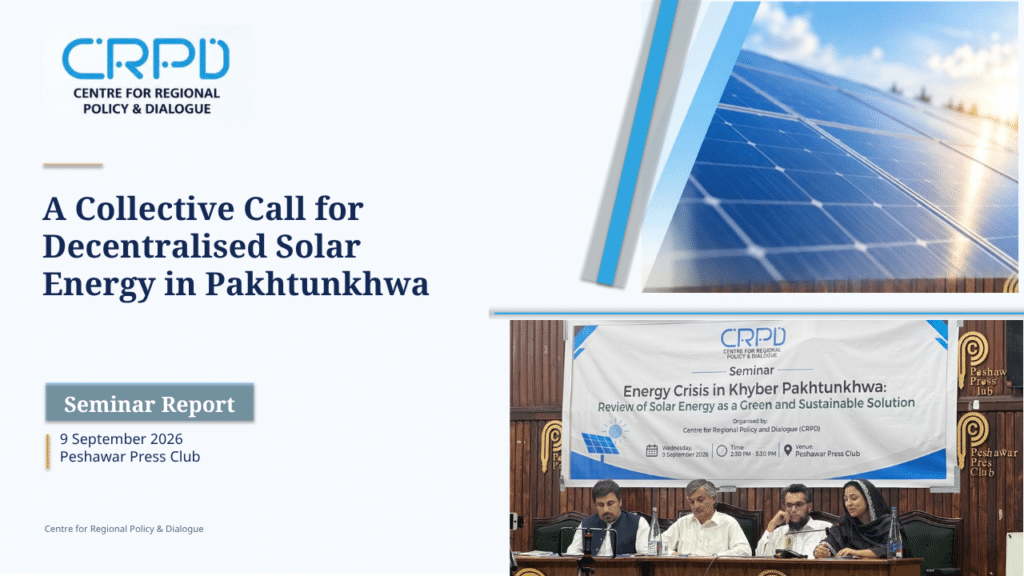
During May, CRPD continued its advocacy engagement with political parties and parliamentarians in Khyber Pakhtunkhwa to promote:
- Solar energy expansion.
- Battery Energy Storage Systems (BESS).
- Decentralized energy grids and microgrids.
- Tax relief for solar panels and battery technologies.
- Dedicated budget allocations for renewable energy.
Consultations held with representatives of ANP, PPP, PML-N, and members of the Khyber Pakhtunkhwa Assembly highlighted increasing political interest in renewable energy solutions as part of a broader strategy to address the province’s energy challenges.
A related discussion featuring Mian Iftikhar Hussain’s support for solar tax reductions and decentralized energy systems was also highlighted through public outreach and advocacy efforts during the month.
Reference:
CRPD Advocacy Engagements – May 2026
https://www.facebook.com/share/p/1NPwiu1cAk/?mibextid=wwXIfr
Key Takeaways
- Solar energy continues to gain political and public support across Pakistan.
- Mian Iftikhar Hussain’s call for solar tax relief and decentralized energy systems reflects growing recognition of renewable energy as a policy priority.
- Debate over net-metering reforms remains active, with stakeholders seeking a more supportive framework for rooftop solar.
- Regulatory easing for small solar consumers may accelerate adoption.
- Battery storage and decentralized grids are increasingly emerging as important components of Pakistan’s future energy strategy.
- Civil society organizations and political actors are actively engaging on renewable energy policy ahead of upcoming budget and legislative discussions.