
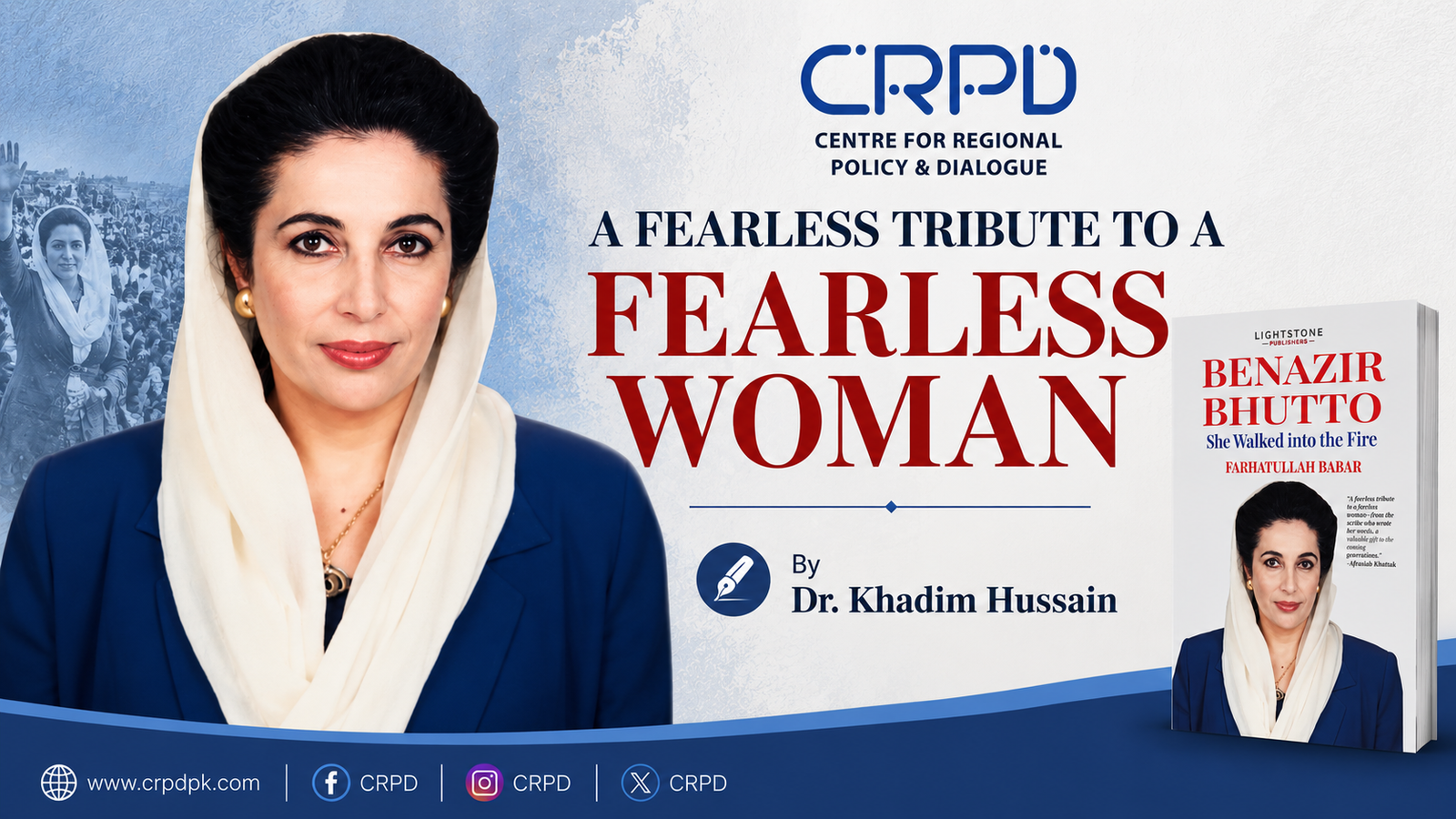
Great books pierce through a reader’s heart and mind, shatter a perceptional architecture and upend the universe of assumptions. They usually trigger unfathomable thoughts and emotions of a reader, and induce her to recalibrate reflections and re-configurate contemplations. After thoroughly reading a great book, a reader feels more intelligent and wiser than before, and she quietly starts thinking that she might have been an absolute ignorant if she had not digested the text of a great writer. One is tempted to quote an almost cliched statement by the English philosopher and Lord Chancellor of England under King James I, Francis Bacon, after reading Senator Farhatullah Babar’s Benazir Bhutto: She Walked into Fire that “some books are to be tasted, others to be swallowed, and some few to be chewed and digested; that is, some books are to be read only in parts; others to be read, but not curiously; and some few are to be read wholly, and with diligence and attention.” The recently published book by Senator Farhatullah Babar falls in the third category as it deserves to be chewed and digested.
Senator Farhatullah Babar’s recently published book Benazir Bhutto: She Walked into Fire, published by Lightstone Publishers in 2026, is one of the few rare books that smashes one’s emotional fortress that one tempts to build around one’s Self, and pulverizes the intellectual citadel that one is enticed to construct around her mind for the sake of warding off unforeseen dangers. This book certainly disarms a reader. With his peculiar eloquence of idioms, majestic style, simple but elegant diction, and exalted narration which make the book far more enjoyable than one expects, Senator Farhatullah Babar has not only chronicled an era of a fearless democratic struggle, an unparalleled “resistance without rupture”, and has not only paid a fearless tribute to a fearless woman, but he has also uncovered the labyrinths and complexity of wheels within wheels of a tightly contested and intricately convoluted structures of political power system in Pakistan.
More than that, the book seems to be an excruciating charge sheet against the anti-democratic supra constitutional forces, politicised judiciary, sections of the engineered media, silence of an oppressed civil society, and retreat of some manipulated political parties that have been micromanaged by the anti-democratic forces in the country. The book by Senator Babar literally brings out the rot that has been eating into the vitals of Pakistan’s political, social, economic, and security state infrastructure. For those who wish to see deeply into the veins and arteries of the foreign-sponsored elitist machinations, callous gimmicks for the control of power, intrigues and maneuverings for taking over state resources, misuse of religion for retaining power, and militarisation of state policies, this book presents an authentic account.
Senator Farhatullah Babar was engaged as the prime minister’s official speech-writer by Shaheed Mohtarma Benazir Bhutto (SMBB) during her first government (1988-1990). During her second stint in the office (1993-1996), Senator Babar was initially appointed as the PM’s Deputy Press Assistant under Hussain Haqqani but when Hussain Haqqani moved on to become secretary information, Senator Babar succeeded him as press assistant and spokesperson to the prime minister. Not only due to his official position that Senator Babar had acquired an intimate understanding of SMBB’s personality, worldview, and ideals that he could write her biography in the form of somewhat his own political memoir, he had also remained a close associate of the Butto family, a staunch supporter of Pakistan Peoples’ Party (PPP) and a committed democrat throughout his life which had put him in the position of a trusted confidante. Senator Babar’s acumen, his commitment to democratic ideals and human rights, his close connection with and deep understanding of the corridors of power, and his rare quality of articulation all have made him the best person to write this immensely inspiring account of the political life of SMBB, and with it the political history of a whole era. It was perhaps one of the visionary moments that SMBB had told him “FB, note all of this, you may have to write about it someday”.
According to Senator Babar, “this account is being written for the first time, a quarter of century later, not to sensationalise history, but to document a moment when Pakistan’s democratic roadmap was sought to be redrawn in a foreign land, without its people’s consent. Benazir Bhutto had asked me to keep meticulous record of communications. She understood the potential value of the algorithms of all this in making sense of Pakistan’s troubled relationship with democracy, power and foreign interventions”. Several important themes that have been unwrapped in this account seem to make a large reservoir of information for the students, researchers and activists of politics and history in Pakistan—human dimensions of the personality of a two-times prime minister of Pakistan and a marvelous larger than life woman leader who was assassinated in the 50th decade of her life, her understanding and views about militancy, terrorism and non-state actors, her viewpoint on nuclear proliferation, her visualisation in the contested area of foreign policy, her grasp of minute details of the way the judicial establishment works in Pakistan, her grip over the formation of media narratives in Pakistan, and her command on and commitment to feminist struggle and resistance to the institutionalised patriarchy.
SMBB was in her twenties when her father, Zulfiqar Ali Bhutto, was overthrown, imprisoned and eventually hanged by a military dictator, General Zia-ul-Haq. Her mother, Begum Nusrat Bhutto, a woman of indomitable spirit, suffered repeated incarcerations, physical abuse and endured the hanging of her husband as well as the murder of her two sons in the prime of their lives. For almost a decade, SMBB was a single mother. Her husband, Asif Ali Zardari was imprisoned, cut-off from his children during their most formative years. “With quiet poignancy, she once said to me that Asif was released from jail only after the children had grown and could no longer sit on the father’s lap”, Senator Babar writes. These personal sufferings had perhaps infused SMBB with the fire of creative sensitivity inspiring her to love poetry as it usually touches the inner chords of hearts. She creatively channelized her pent-up sufferings but the anguish of mounting hardships never broke her resolve—she never surrendered and never retreated. “Her spirit, her will and her resilience endured”, Senator Babar believes.
She would recite a revolutionary poem by Khalid Javed Jan ‘Main Baghi Hun’ (I am a rebel) in large public gatherings when she waged a resistance movement against the dictatorship of Zia-ul-Haq. She rendered both the poem and the poet immortalized. Inspired by the 17th century great Sindhi poet, Shah Abdul Lateef Bhitai, and his poem ‘Marvi of Malir’, she herself penned a lengthy poem on her 50th birth day, ‘Story of Benazir: From Marvi of Malir and Shah Lateef’, which ends on this stanza:
The desert wind calls
Marvi calls…
Children: Hear the desert wind
Hear it Whisper
Have faith
We will win.
Senator Babar has highlighted an interesting personal quality of SMBB’s personality, which is, although not unusual in world leaders, is quite rare in the political circles of Pakistan in the present era—her voracious and avid reading habits. He saw that SMBB would thoroughly read “press summaries, editorial digests and radio monitoring reports daily—both national and international. These weren’t cursory glances. Quite often, she annotated margins, questioned claims, rebutted allegations, and occasionally gave directions on how the party or the government should respond”. Senator Babar is of the view that the “handwritten remarks she left on press clippings are, to this day, invaluable indicators of her mindset and commitment” and “must be compiled separately”.
One of the most challengingly existential but intertwined issues that Senator Babar has put into words in this account—and which has continued to plague the sociocultural, geopolitical and sociopolitical milieu of Pakistan, particularly in Khyber Pakhtunkhwa, Balochistan and urban centres of Punjab and Sindh, and which had occupied SMBB both on policy and political levels—is the issue of fanaticism, militancy, terrorism & non-state actors, and nuclear proliferation. Through narrating the story of three characters—(Major) Mast Gul, a Hizb-i-Islami commander, Ramzie Yousaf, an al-Qaeda-affiliated lone wolf, and Khalid Khwaja, ostensibly belonging to a secret service of the country—Senator Babar has fearlessly brought out the links between geostrategic machinations through non-state actors, armed private militias, and “rogue elements” within the deep state. He believes that “Benazir Bhutto understood, more than most, that militancy was not born in mountains—but in the corridors of unchecked power. She knew that while poverty and ideology provided the foot soldiers, the architecture of terror was political—often shielded, sometimes even sanctioned, by elements within those who claimed to protect the state”.
In Senator Barbar’s opinion, SMBB “was alarmed by the state’s reliance on non-state actors to project power beyond its borders…An economically impoverished country projecting power beyond borders through non-state actors, while brandishing nuclear umbrella, could gravely undermine national security. The consequences of that policy became glaring in March 1993 (Mian Nawaz Sharif was prime minister at that time) when a series of bomb blasts ripped through Mumbai. Benazir Bhutto remarked at that time that it presented an opportunity to bring intelligence services under civilian oversight—an opportunity squandered.”
Another most significant issue that Senator Babar has discussed in this account with reference to SMBB is the fiercely contested area of foreign policy of Pakistan. Senator Babar has particularly focused on relations with India, Afghanistan and the United States of America. Even during her first stint in office between 1988 and 1990 when SMBB had to make a compromise to have Sahibzada Yaqoob Ali Khan as her foreign minister and Ghulam Ishaq Khan as the president of Pakistan, the two apparent choices of the establishment, she had struggled to bring the foreign policy within the domain of elected civilian authority. Senator Babar concludes that “despite several formidable challenges, Benazir Bhutto brought to foreign policy the same grit and vision that defined her resistance to dictatorship. She understood the symbolic power of diplomacy and deftly used her limited space to build credibility, foster regional dialogue and project Pakistan’s civilian leadership on the global stage—something deeply resented by the deep state”.
During the 1988 South Asian Association for Regional Cooperation (SAARC) conference in Islamabad when she had just taken oath as prime minister “she and Indian Prime Minister Rajive Gandhi signed a landmark agreement on the non-attack of each other’s nuclear facilities”. Senator Babar thinks that SMBB “saw India not as a rival but as a market for Pakistani goods and a potential partner”. He further elaborates that “advocating for a cooperative framework akin to the India-China model, she said in a 1996 address at the Institute of Strategic Studies in London, “Normal and friendly relations between India and China are a factor for peace and stability—and so can be friendly relations between India and Pakistan”.
Senator Babar is of the view that the elected leadership of Afghanistan had great expectations from SMBB for normalising relations and bringing peace in the region. Senator Babar maintains that “President Hamid Karzai of Afghanistan respected her immensely. He believed she could have been a credible partner in tackling militancy and cross-border terrorism. The two met in Islamabad, just hours before the fateful rally at Liaquat Bagh on 27 Dec 2007.” Ironically, interior minister during SMBB’s second stint in power (1993-1996), late Naseerullah Babar, was widely seen as the brains behind the Taliban in Afghanistan. Senator Farhatullah Babar might have devoted some space for discussion on the intricacy of the issue in his account, but he has avoided to dilate on this issue for the reasons best known to him.
The long history of Pakistan-US relations, which dates back to the initial years of Pakistan’s inception, has remained one of the recurring issues in the foreign policy of Pakistan. Majority of scholars and analysts believe that these relations have remained transactional, security-based, and have usually flowered during the authoritarian regimes in Pakistan. Senator Babar believes that SMBB “aspired to transform Pakistan’s relationship with the United States from a transactional arrangement to a broad-based partnership. She believed that relationship grounded solely in security cooperation between the Pentagon and the GHQ tended to undermine the country’s democratic political structures”.
One of the most revealing narrations in the account by Senator Farhatullah Babar may be the details of backchannel negotiations between SMBB, while she was still in exile, and the then military ruler of Pakistan, General Pervez Musharraf, from 2001 till 2007. Senator Babar had been privy to, and most of the times even participant of, these negotiations which were initially carried out through a messenger of the US administration, who Senator Babar has named as Mr. Tee, and later directly between the SMBB’s team and Musharraf’s team. The initial draft for backchannel negotiations presented for discussions by Mr. Tee on behalf of the American establishment contained that SMBB should wait “four to five years” before returning from exile allowing Musharraf to complete his so-called “cleansing work”, and that there should be constitutional amendments that should include limiting the prime minister to two terms, reducing the PM’s term from five to four years, and introducing the constitutional role for the military. “My mind swirled at the idea of a constitutional role for the military funneled from Washington” and which “has long been on the military’s wish list”, Senator Babar writes.
Senator Babar has informed us that in her terse and clear response, SMBB asserted that “any attempt to broaden the scope of negotiations to include constitutional engineering would be rejected. She refrained from using the words “constitutional role for the military “to deny any legitimacy to the abhorrent idea”. In the same chapter of the book, Senator Babar writes that “when, in Nov 2025, the 27th constitutional amendment was passed, fundamentally altering the balance of power between the civil and the military, my mind went back to Benazir Bhutto and her refusal to accept outlandish proposals aimed at legitimising any role for the military in politics. She had stood her ground even in exile and could possibly end it early by accepting such demands”. The intricate issue of the civil-military relations in the political system of Pakistan has also been adequately illuminated by Senator Babar through the description of a significant meeting between Mian Nawaz Sharif and SMBB at the Zardari House Islamabad in Dec 2007 days before her assassination. During this meeting, according to Senator Babar, both leaders of the large political parties of Pakistan had made a commitment to find a way to put a stop to the repeated intervention, derailment of the political process and subversion of the constitution every few years.
In this spine-chilling account, Senator Farhatullah Babar has informed us about the well-founded views of SMBB regarding judges and judiciary. She believed, he tells us, in the majesty of justice and judiciary, not individual judges. As for her feminism, Senator Babar notes that SMBB, through her policies and actions, had consistently struggled to shatter the very foundations of the institutionalised patriarchy permeated in the social and cultural veins of the society.
Senator Farhatullah Babar has mentioned, and sometimes referenced, some interesting books in his account of the era and personality of SMBB. Fortunately, I read almost all these books the year they were published and found a few of them highly interesting. These books include Ron Suskind’s The Way of the World, Condoleezza Rice’s No Higher Honour, Gorden Corera’s Shopping for the Bomb, SMBB’s Reconciliation, Pervez Musharraf’s In the Line of Fire, and Justice Sajjad Ali Shah’s Law Courts in Glasshouse. Senator Babar has mentioned several political and social personalities in this account, some of whom he seems to hold in high esteem, such as Makhdoom Amin Fahim and Syed Khurshid Shah (Yamama of Arabia).
The two heart-wrenching, harrowing and tormenting fateful events that Senator Farhatullah Babar has penned in this account envelop the reader into a melancholic disposition. One of them is the saga of Swiss cases against SMBB and Asif Ali Zardari. With his heart-touching style, Senator Babar has described the psychological and political toll that these cases exacted on SMBB which frustrated her to the extent that she almost decided to quit politics and spend time with her family. This shocking saga tells us how manipulated dispensation of justice and the mud thrown at her could push even the iron-willed lady into despair.
Senator Farhatullah Babar’s hour-to-hour commentary, from Dec 26 till the evening of Dec 27 2007, of one of the most agonising and unendurable events of the political history of Pakistan, the assassination of Shaheed Mohtarma Benazir Bhutto, in his account Benazir Bhutto: She Walked into Fire makes even the most stone-hearted person shed tears. The narration of her assassination in the book carries perhaps the highest value of a masterpiece fiction—but it was a reality no body wishes to accept. In the last words of the description: “And so, with hearts shattered and history changed, we flew with Benazir Bhutto on her final journey. A leader had fallen, a nation grieved and wept. It was a day when democracy was shot. Her last journey to her final resting place began”.
(The writer is analyst, author and researcher based in Islamabad. He can be accessed via khadimhussainpajwak@gmail.com)

2 Comments
great analysis
A great commentary on a wonderful book by Farhat Ullah Babar sb.Khadim Hussain sb has summarised and commented on the book in a masterly way.