How Tax Incentives, Government Support, and Local Manufacturing Can Drive Sustainable Economic Growth
By Hazer Gull
The upper districts of Pakistan are currently facing severe economic pressure due to rapidly rising electricity prices and an unreliable energy supply. In Swat alone, approximately 3,000 commercial members are registered. Beneath this formal sector, however, lies a vast undocumented and informal economy, similar to other districts of Khyber Pakhtunkhwa, comprising more than 100,000 small and medium-sized enterprises. These include the traditional industries of Islampur, Swat, tourism-related hotels and guest houses, workshops, and small retail businesses. Since these enterprises possess very limited financial safety nets, the unbearable cost of electricity has become a serious threat to their survival. In this context, solar energy is no longer merely an alternative source of power but has become an essential and indispensable instrument of economic security.
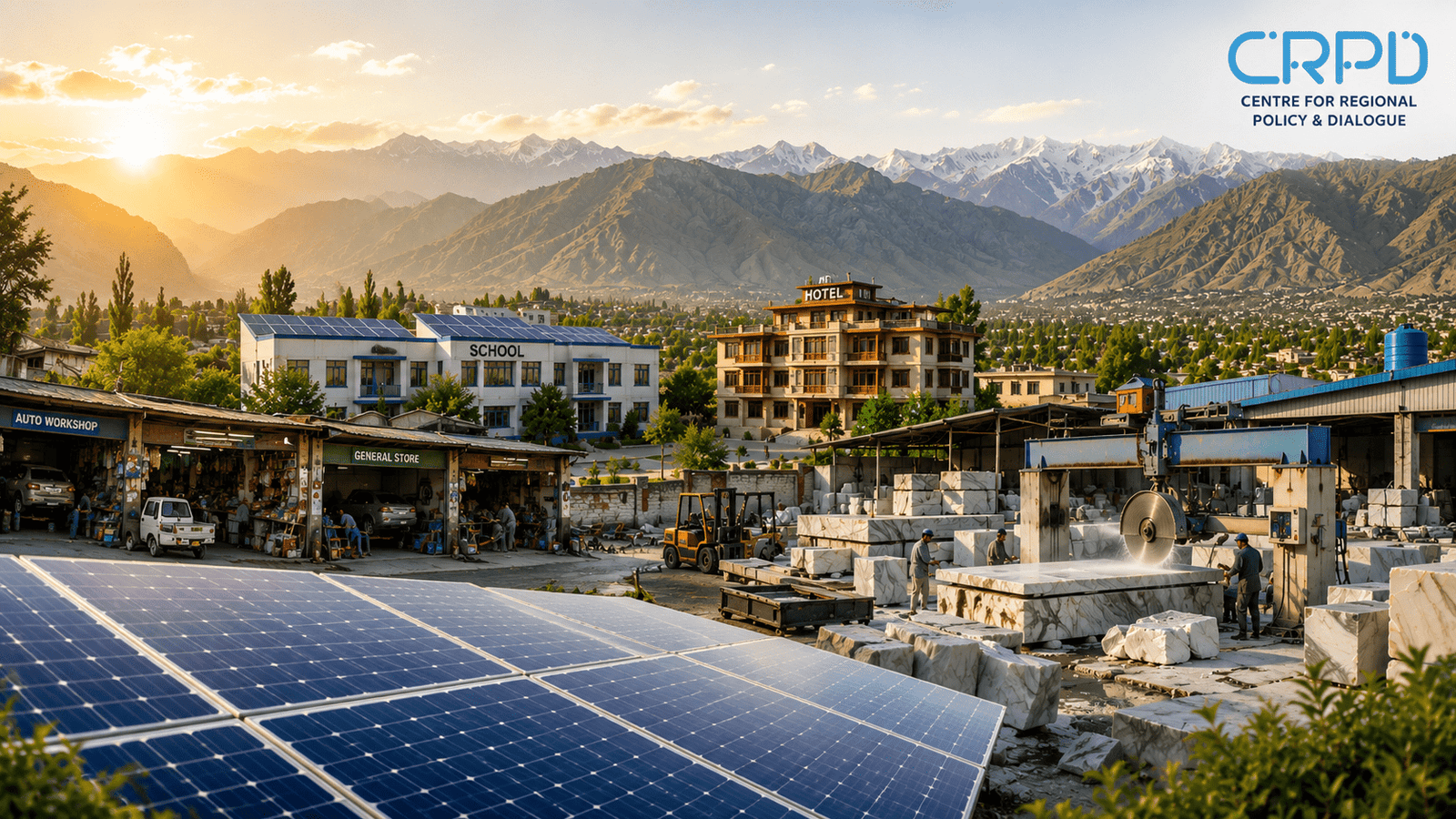
During the summer season, electricity demand in Swat rises significantly, placing enormous pressure on the already weak and loss-ridden network of the Peshawar Electric Supply Company (PESCO). The situation in the neighboring district of Buner is even more critical. Buner produces more than half of Pakistan’s total marble output. The district’s heavy cutting blades and marble processing plants depend on an aging and fragile regional grid station. Frequent power outages lasting several hours each day force factories to operate expensive diesel generators to maintain production. This not only increases manufacturing costs but also causes costly damage to machinery due to sudden voltage fluctuations. Under these circumstances, a sustainable multi-sector model can be established by transitioning private schools, automobile repair workshops, and marble-processing industries to solar energy.
A major cause of this crisis is the high level of transmission losses, technical inefficiencies, and widespread electricity theft. The financial burden of these losses is ultimately transferred to honest consumers and industries through higher tariffs and surcharges. When businesses adopt on-grid and hybrid solar systems, electricity is generated directly at the point of consumption, eliminating transmission losses and improving the overall efficiency of the power system. Private schools operate during daylight hours and can therefore meet virtually all of their daytime electricity needs through solar power. During summer vacations, surplus electricity can be sold back to the center grid, potentially offsetting winter electricity bills. Similarly, automobile workshops that rely heavily on welding equipment and air compressors can utilize solar energy to maintain uninterrupted operations and extend working hours into the evening. Large marble factories, if connected to industrial-scale solar networks, can significantly reduce their dependence on costly grid electricity and diesel fuel. This would lower production costs per square foot and help safeguard thousands of local industrial jobs.
To make this large-scale transition possible, the government must adopt a comprehensive and strategic multi-dimensional approach that combines both cluster-based local grid systems and individual facilitation. In areas where businesses and factories operate in concentrated clusters—such as Buner’s marble sector, Islampur’s handloom cluster, and Mingora’s automobile markets—the government should establish small-scale grid-based solar networks. These centralized solar grids would provide affordable electricity collectively to entire industrial clusters, eliminating the need for factory owners to make large individual investments. Conversely, in areas where businesses are scattered and clustering is not feasible, the government should actively encourage and facilitate individual solar installations. For this dual model to succeed, the government must take a leading role by providing substantial tax exemptions, financial grants, subsidies, and the initial capital necessary for the transition. The Sarhad Rural Support Program is currently implementing an initiative aimed at promoting small business development and employment generation by offering matching grants of up to PKR 2 million. Similar programs could play a significant role in supporting the transition to solar energy.
The government should abolish all import duties, sales taxes, and regulatory taxes on solarization-related equipment. Such exemptions should cover not only solar panels but also modern batteries, inverters, net-metering equipment, and installation hardware. A reduction of 20–30 percent in upfront costs could provide the crucial incentive needed for small businesses and school administrations to adopt clean energy solutions and escape the burden of high electricity bills.
Furthermore, long-term reliance on imported equipment is not a sustainable solution. Genuine economic self-reliance can only be achieved when the government actively promotes domestic manufacturing of solar-related technologies. To achieve this objective, aggressive incentive packages should be introduced, including the provision of low-cost land in industrial zones, ten-year tax holidays, and duty-free import of manufacturing machinery. Local assembly and production of solar panels and inverters would not only conserve foreign exchange reserves but also create thousands of high-skilled jobs for the youth of Khyber Pakhtunkhwa as assembly-line workers, technicians, and energy auditors.
The expansion of decentralized solar energy represents one of the most effective means of reducing the structural burden on Pakistan’s electricity system, which is already strained by electricity theft and transmission losses. At the same time, it lowers the fixed operating costs of micro and small industries. The time has therefore come for the government to align its energy policies with the economic realities of the region and make solar energy a central pillar of sustainable economic development.