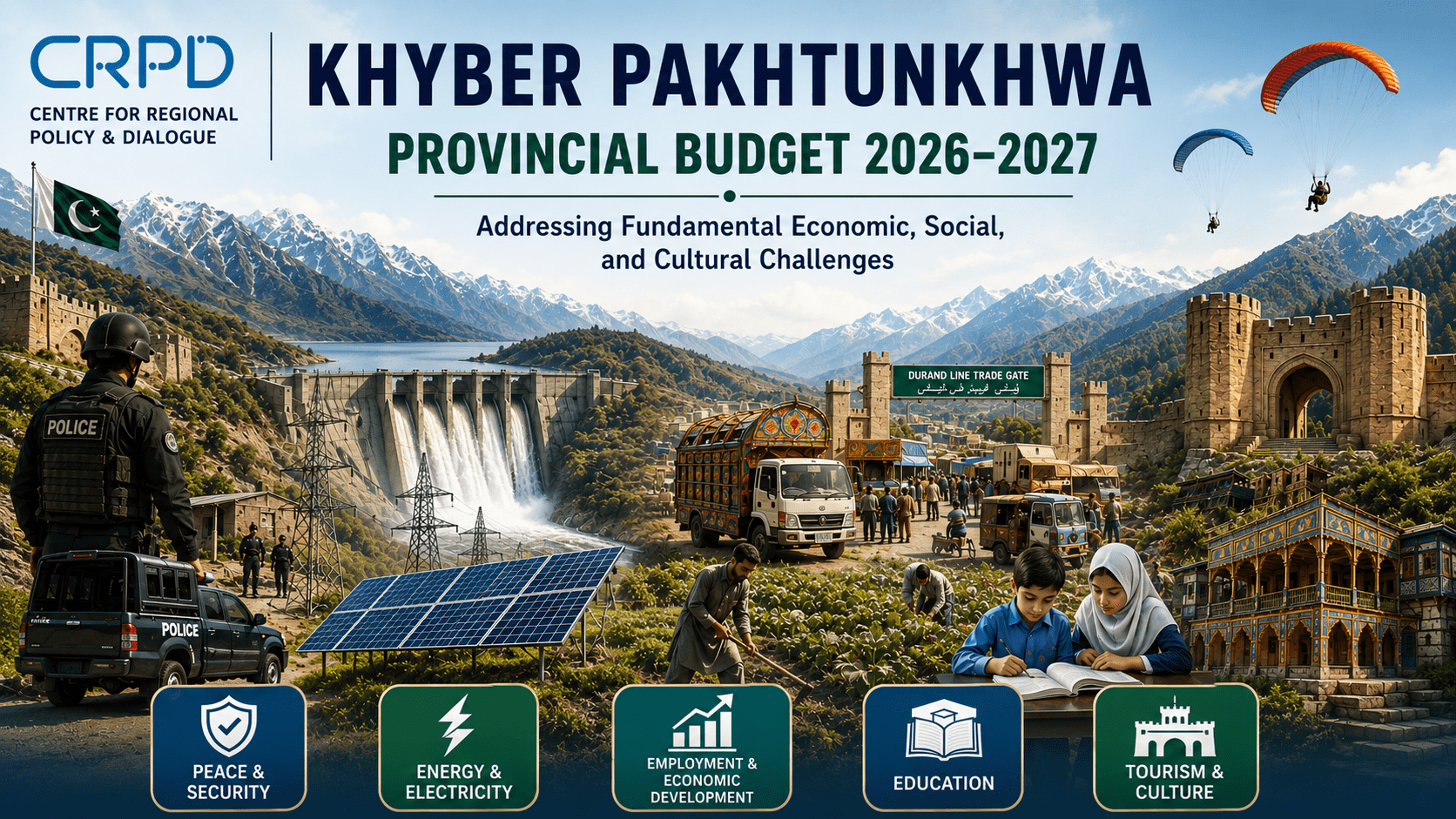
Even a casual observer can identify hundreds of challenges facing Khyber Pakhtunkhwa, but five issues stand out as particularly fundamental: peace and security, energy and electricity, employment, education, and tourism and culture.
At first glance, it is evident that 92% of Khyber Pakhtunkhwa’s budget depends on transfers from the federal government, a source that cannot always be relied upon with certainty. Secondly, 33% of the province’s budget remained unspent (lapsed) last year, and it remains to be seen what the situation will be this year. Thirdly, serious audit observations have been raised regarding provincial expenditures in recent years, while numerous financial scandals have repeatedly surfaced in the media. The Kohistan financial scandal is perhaps the most prominent example. In addition, serious questions have been raised about the Sehat Card program, the Peshawar Beautification Project, funds allocated to the merged districts, and several infrastructure projects. What actions the provincial government has taken in response to these observations, scandals, and concerns remains unclear. There appears to be little evidence in the current provincial budget of a strategy to address these issues.
Peace and Security
Has an adequate budget been allocated to equip the Counter-Terrorism Department with modern facilities to help restore peace? Has funding been earmarked for modern policing technologies, salary increases, and improved facilities for the police force? Has any budget been allocated to strengthen academic, cultural, and social institutions that can help develop public narratives against religious extremism and militancy? If the answer is yes, how much has been allocated? More importantly, is that amount sufficient to address terrorism and extremism across more than half of Khyber Pakhtunkhwa, where police continue to face attacks?
Will it help prevent the continued displacement of people from several districts of the province? These are critical questions because sustainable development, economic growth, and social stability all depend upon peace and security.
Energy and Electricity
Affordable electricity and energy are essential not only for households but also for markets and industrial development. Khyber Pakhtunkhwa cannot resolve its energy crisis unless the provincial government undertakes three key measures.
First, it must secure hydropower royalties and dues from the federal government under Article 161(1) of the Constitution. Second, it must conduct a comprehensive assessment of hydropower projects, including their costs, benefits, impacts on local communities, and the actual cost per unit of electricity. Third and most importantly it must exercise its constitutional authority under Article 157 to establish alternatives to the centralized federal grid through localized and decentralized energy systems.
As long as the centralized and inflexible grid structure remains unchanged, it will be difficult to provide sufficient and reliable electricity to households, businesses, and industries across the province.
It is a well-established fact that Khyber Pakhtunkhwa has hosted the largest number of hydropower projects in Pakistan for more than six decades. Many of these projects displaced thousands of people, destroyed forests, dried up natural springs, disrupted ecological balance, and contributed to cultural dislocation. Yet the affected communities have not received affordable electricity, fair compensation, meaningful economic benefits, thriving markets, or industrial growth. Even today, communities affected by the Dasu Dam continue to protest for adequate relief and compensation.
Ordinary citizens are increasingly attempting to generate their own electricity by installing solar panels and inverter systems. However, these efforts have come under threat as the federal government has imposed an 18% GST on solar panels and a 45% tax on battery storage systems. Although some federal ministers later announced that the GST on solar panels would be retained as 10%, but still these taxes have been widely regarded by citizens as unaffordable. Had the provincial government allocated resources under Article 157 for solarization, mini and micro-grids, battery energy storage systems, and transmission infrastructure upgrades, it could have stimulated economic activity and improved energy access throughout the province.
Employment and Economic Development
Employment remains one of the most pressing challenges facing Khyber Pakhtunkhwa. The provincial economy relies heavily on six major sources.
The first is remittances sent home by workers employed abroad. The second is cross-border trade along the Durand Line, stretching from Arandu in Chitral to Angoor Adda in South Waziristan. This trade supports hundreds of thousands of families through import-export activities, transportation services, and related businesses. The closure of trade corridors has rendered many people unemployed and pushed numerous families into economic hardship. Many have been forced to relocate their limited capital to cities in Punjab and Sindh, where they face new challenges.
Agriculture forms another major pillar of the provincial economy. Crop cultivation, vegetable farming, and fruit orchards dominate the plains, while orchards, livestock, and dairy production are common in mountainous regions. Nearly two-thirds of the province’s cultivable land lacks adequate irrigation. Farmers either do not have access to electricity for tube wells or face electricity costs so high that they cannot afford to operate them.
This raises important questions about budget allocations for irrigation systems, agro-based industries, youth skills development, entrepreneurship, livestock development, and broader economic growth initiatives. What measures does the provincial budget propose to reduce unemployment and promote economic opportunity?
The services sector, skilled labor, and small- and medium-scale industries constitute another critical source of employment. Industrial centers in Gadoon Amazai, Hattar, Peshawar, Nowshera, Swat, and Mardan have witnessed prolonged decline. Small industries either lack access to electricity or face energy costs that make production economically unviable.
For these industries to thrive, affordable and clean energy must be made accessible through investments in local, micro, and mini-grids, modernization of transmission infrastructure, and the establishment of solar parks. The provincial government possesses constitutional and administrative authority under Article 157 and the PEDO framework to pursue such initiatives. Public investment in solar panels and battery energy storage systems has become increasingly necessary if industrial activity and market growth are to be revitalized.
The situation for medium-scale mining and construction contracting is equally concerning. Several central and security-related institutions have effectively established dominance over these sectors. As industrial activity declines and markets remain sluggish, the services sector continues to contract.
Consequently, Khyber Pakhtunkhwa remains trapped in a cycle of unemployment. One of the factors contributing to the continued recruitment of young people by extremist and militant organizations is the absence of meaningful economic opportunities and sustainable livelihoods.
Education
The fourth major challenge facing Khyber Pakhtunkhwa is education. At first glance, the allocation of PKR 468 billion for education appears substantial and impressive. However, the key question is whether this allocation adequately addresses the province’s growing crisis in educational access, quality, and governance.
According to Dawn, literacy rates in Khyber Pakhtunkhwa range between 51% and 58%. Gallup Pakistan estimates female literacy at only 37%. The Free and Fair Election Network (FAFEN) reports an overall literacy rate of just 35% in the merged districts, with female literacy rates considerably lower. These figures imply that nearly 45 out of every 100 boys and approximately 60 out of every 100 girls remain out of school.
Government statistics indicate that the province has 34,784 schools with the capacity to accommodate approximately 5.09 million students. Yet many districts in the merged areas and Kohistan continue to suffer from inadequate educational infrastructure and teacher absenteeism.
Textbook shortages remain a serious concern. As recently as this month, teachers in Chagharzai Tehsil of Buner district reportedly organized donation drives to obtain textbooks for students midway through the academic year. The curriculum itself remains problematic, with students continuing to encounter content that promotes exclusionary attitudes and extremist narratives.
The examination system faces recurring credibility issues, including annual question paper leaks and grading irregularities that undermine public confidence in educational institutions.
Given these realities, questions naturally arise regarding how and where the education budget will be spent. Last year, nearly 28% of the education budget either lapsed or proved insufficient to meet existing needs.
The budget allocates PKR 45 billion for higher education. However, many universities continue to struggle financially. Faculty salaries are often delayed, promotions remain stalled, and funding for teaching and research activities is inadequate. The Higher Education Department oversees approximately 310 public degree colleges and around 40 public and private universities. Spread across these institutions, the allocated funds appear insufficient to meet operational requirements, raising serious concerns about the sustainability and quality of higher education in the province.
Tourism and Culture
Tourism and culture represent both a major challenge and a significant opportunity for Khyber Pakhtunkhwa. Surprisingly, no dedicated budget has been allocated specifically for sports, tourism, and culture. Instead, these sectors have been subsumed under the broader Annual Development Program (ADP) allocation of PKR 524 billion.
The province possesses immense tourism potential. In southern districts, areas between Wana and Miranshah, as well as Parachinar, Tirah Valley, Orakzai, and Khyber districts, could generate substantial economic activity through tourism development. Similarly, northern districts such as Chitral, Dir, Swat, Shangla, Abbottabad, Mansehra, and the Galiyat region have the capacity to generate billions of rupees annually through a well-developed tourism sector.
However, realizing this potential depends on peace, security, and the provision of basic infrastructure and public services. This makes transparent and adequate budget allocations for tourism development a critical policy issue.
No society can thrive without preserving its cultural heritage and fostering cultural creativity. Over the past several decades, Khyber Pakhtunkhwa’s creative cultural sectors including literature, music, film, drama, and theatre as well as productive cultural industries such as handicrafts, leatherwork, woodworking, traditional textiles, footwear, furniture, beverages, and local food products, have experienced significant decline.
The province’s cultural and linguistic diversity represents an invaluable source of social and economic wealth. Yet this rich heritage has been weakened by terrorism, extremism, and prolonged governmental neglect. Reversing this trend requires not only adequate funding but also the establishment of high-quality institutions dedicated to cultural preservation, promotion, and innovation.
Unfortunately, cultural departments and archaeological institutions in Khyber Pakhtunkhwa continue to suffer from inadequate funding and limited institutional support. Before irreversible losses occur, urgent and sustained attention must be directed toward protecting and revitalizing the province’s cultural heritage.
Conclusion
The central question remains whether the Khyber Pakhtunkhwa Provincial Budget 2026–2027 represents a serious and coherent strategy for addressing the province’s most pressing challenges, or whether it is yet another example of populist budgeting that prioritizes political optics over substantive reforms.
Without meaningful investments in peace and security, affordable and decentralized energy systems, employment generation, educational reform, tourism development, and cultural revitalization, the province may continue to struggle with the very challenges that have constrained its development for decades.
(The writer is Director Research and Publications at the Centre for Regional Policy & Dialogue (CRPD) Islamabad, and can be accessed via khadimhussainpajwak@gmail.com)