Adnan Ali Khan
Introduction
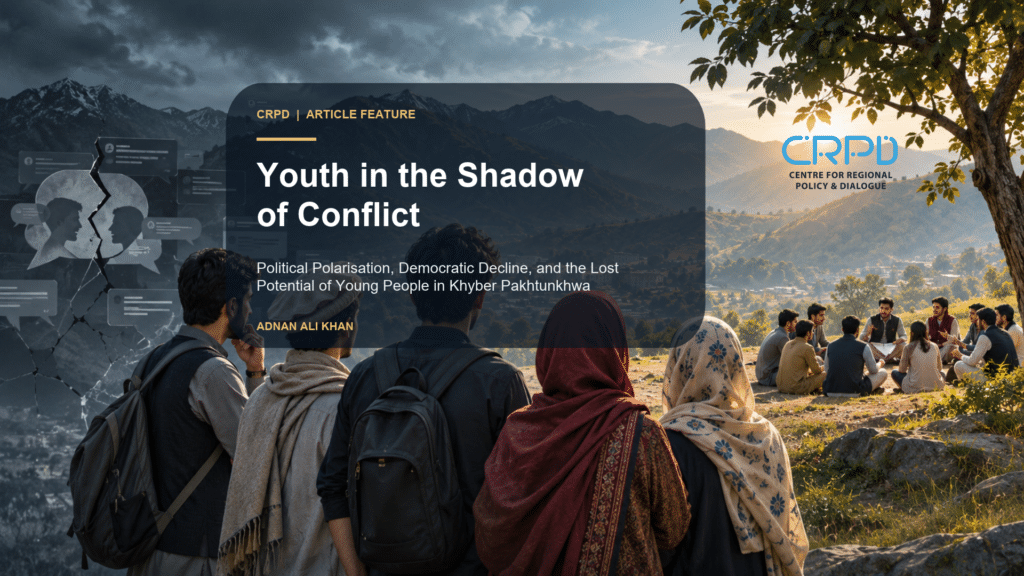
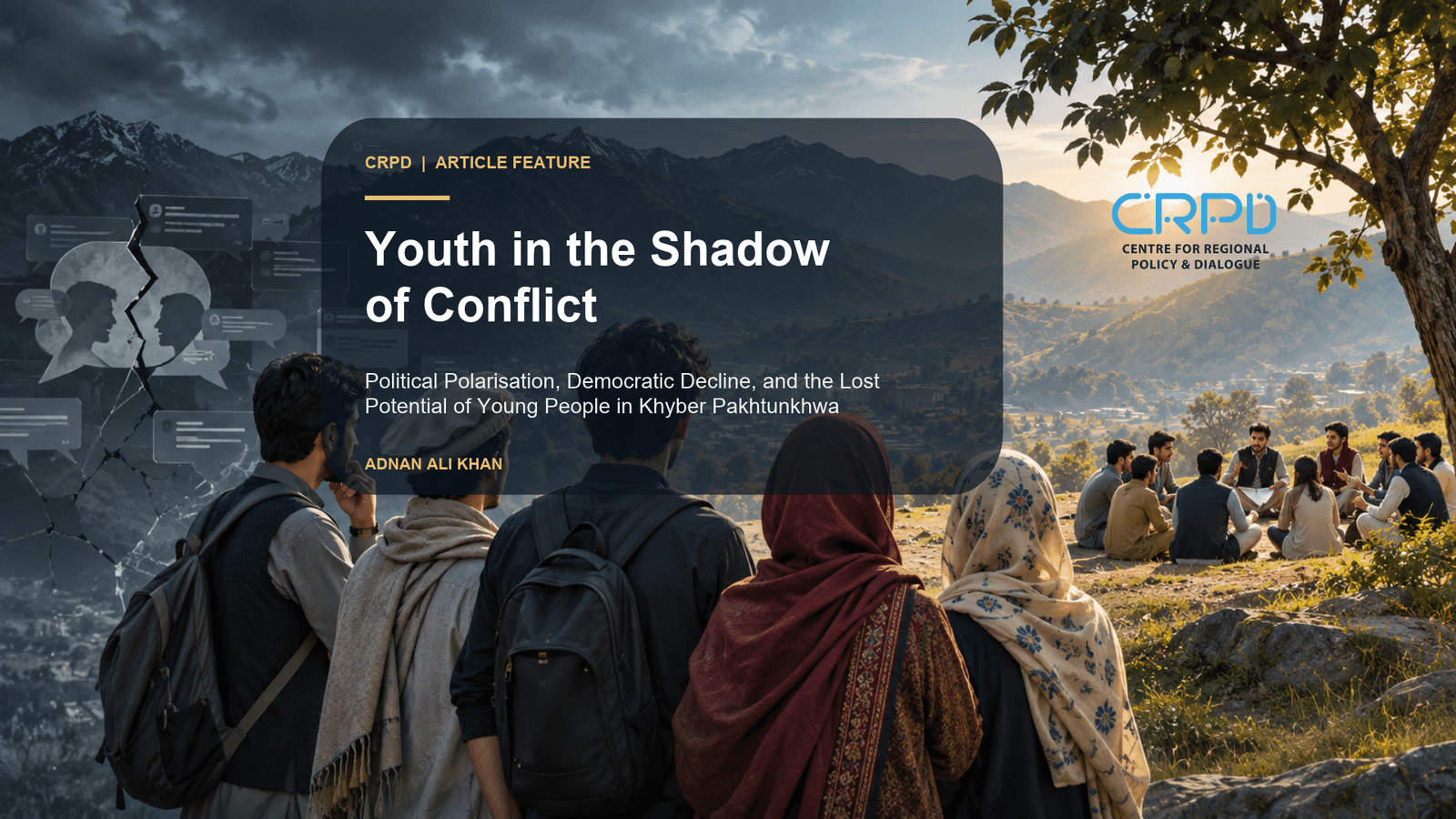
Khyber Pakhtunkhwa has experienced decades of political polarisation, violent extremist violence, insecurity, and democratic conundrum. During the whole of this period, young people, who should have been at the forefront of permeating political consciousness, democratic development, and social transformation, increasingly became trapped in unnecessary political conflicts, cult following, Messiah Syndrome, and confrontational behaviour. Instead of nurturing a generation capable of questioning political leadership and demanding accountability, the province witnessed the growing influence of exclusionary and divisive political narratives that weakened constructive political engagement.
My primary concern is not simply which political party gained or lost power in Khyber Pakhtunkhwa. Rather, it is how this political process affected the thinking, attitudes, and political participation of our youth, and how their attention was gradually diverted from the real challenges facing the province. It constitutes a visible manifestation of populism—imagining an easy solution to the complex problems, a strong leader and rightist authoritarianism. The political parties and independent analysts believe that rise of populism was predominantly caused by the increasing influence of Pakistan Tehrik-e-Insaf (PTI) in the province.
1. The Rise of PTI and the Changing Political Narrative
Pakistan Tehreek-e-Insaf (PTI) adopted a populist social media strategy in Khyber Pakhtunkhwa, primarily built around the slogan of eradicating corruption. By presenting the fight against corruption as its central political message, PTI attracted and mobilized young people to promote its narrative on social media. This strategy was also used to portray PTI as an alternative to the traditional democratic political parties, while discrediting their leadership, political struggles, and democratic contributions. Consequently, social media became a platform for promoting PTI’s political narrative and encouraging young people to oppose established democratic parties rather than engage in constructive political debate.
I will not go into the details of how young people in Khyber Pakhtunkhwa were trained or influenced. However, the impact of this process was significant. It gradually created disappointment and distrust among young people towards other political parties and their democratic activities in the province.
A narrative was promoted that only PTI and its chairman, Imran Khan, could bring meaningful change to Khyber Pakhtunkhwa, while other political parties were portrayed as self-serving and interested only in protecting their political and personal interests. As a result, many young people began supporting PTI, believing that it was the only political force capable of delivering the change they wanted.
This political shift was also reflected in their behaviour, particularly during political discussions and on social media. Many young PTI supporters became highly active and aggressive in defending the party’s positions. Whenever members or supporters of other political parties shared their views on social media, they often faced disrespectful, offensive, and sometimes abusive comments. Political disagreements increasingly turned into personal attacks, leaving little room for constructive debate, mutual respect, or healthy political discussion. (The Rise of Populism and the Transformation of Political Culture in Khyber Pakhtunkhwa: A Case Study of Pakistan Tehreek-E-Insaaf, 2013-2025)
2. The Political Victimization of ANP before the 2013 Elections
Before the 2013 general elections, PTI’s political narrative had not yet gained widespread influence in Khyber Pakhtunkhwa. Instead, the Awami National Party (ANP), which was then governing the province, faced an extremely dangerous narrative propagated by the Taliban.
The Taliban openly targeted ANP leaders and workers through violent attacks and intimidation while promoting the message that people should not support ANP because the party opposed the Taliban and their ideology. (The Guardian) (BBC)
This narrative created an atmosphere of fear and insecurity, particularly among ANP supporters and political workers. By portraying ANP as an enemy of the Taliban, militants attempted to discourage people from supporting the party and participating in its political activities. The violence not only affected ANP’s political campaign but also undermined the broader democratic process in Khyber Pakhtunkhwa.
The consequences extended beyond the electoral defeat of a political party. The attacks weakened the political space for democratic forces and created an environment in which political participation became increasingly difficult and dangerous. ANP’s experience demonstrated how violence and extremist narratives could be used to undermine democratic political activity.
3. PTI’s First Government and the Unfulfilled Expectations of Change in Khyber Pakhtunkhwa
Pakistan Tehreek-e-Insaf emerged victorious in the 2013 general elections in Khyber Pakhtunkhwa and formed the provincial government. The people had high expectations of positive change, improved governance, peace, and development. Many young people particularly believed that PTI would introduce a new political culture and address the longstanding problems of the province.
However, the province gradually moved in a different direction from what many had hoped for. Security challenges persisted, instability increased, and people continued to face an uncertain and insecure environment. Public disappointment with the political situation gradually grew, and many people began questioning the promises of change and reconsidering their political affiliations. (The Express Tribune)
Some people also began looking towards other political parties, particularly ANP, which had previously governed the province and had an established political structure and experience in provincial administration.
Nevertheless, the political narrative surrounding PTI continued to dominate much of the public debate. The politically disengaged youth, along with those increasingly involved in aggressive and abusive exchanges on social media, remained confused and continued waiting for Imran Khan’s promised change. Online political conflicts continued, while the province faced persistent challenges in education, healthcare, agriculture, security, and other important sectors.
Despite growing public disappointment, PTI once again secured victory in the 2018 general elections in Khyber Pakhtunkhwa and formed the provincial government for a second consecutive term. By this time, PTI’s political influence had become deeply established in the province, and its return to power further strengthened its position in provincial politics.
4. The Emergence of Pashtun Tahaffuz Movement (PTM) and the Repetition of Political Polarization
My primary concern throughout this political process has been the youth of Khyber Pakhtunkhwa, who were deeply affected by these developments. Over time, a significant section of young people became politically disengaged, less interested in constructive political discourse, and increasingly involved in aggressive and abusive conversations, particularly on social media. In my view, this represents one of our greatest failures.
Meanwhile, the youth of the former Federally Administered Tribal Areas (FATA) began organizing the Pashtun Tahaffuz Movement (PTM) in 2018. Within a short period, PTM emerged as a symbol of hope for peace, justice, and freedom among many young people, particularly those affected by conflict, insecurity, and longstanding grievances in the tribal districts.
The movement gained considerable public support and brought important issues concerning human rights, security, and the rights of Pashtun communities into public discussion. However, despite its growing influence, PTM initially lacked a conventional, well-organized political structure and a clearly defined political manifesto. (EFSAS)
Many young people began supporting PTM with the same level of emotional intensity, aggression, and confrontational language that had previously characterized their support for PTI. In many cases, political disagreements again turned into personal attacks, and criticism of the movement was treated as opposition to its entire cause.
Consequently, instead of developing a culture of constructive political engagement, the same pattern of political polarization and confrontational discourse appeared to be repeating itself. The problem was no longer limited to one political party or movement; it had become a broader issue concerning political attitudes and the political culture of our youth. Two points were particularly of concern to political analysts: first, an outright rejection of parliamentary mode of politics and vociferous criticism of the political parties that were engaged in parliamentary politics. The criticism put various shades of political discourses in the same box irrespective of their ideological differences just because all of them were engaged in the same of mode of parliamentary politics. Secondly, criticism by some who would identify themselves with PTM clearly showed a tilt towards violence and armed struggle. The lack of criticism of TTP by the PTM leadership gave credence to such perceptions.
5. The Current Crisis and the Lost Political Energy of Youth
Today, young people in Khyber Pakhtunkhwa are increasingly engaged in blaming one another, diverting their attention from the province’s real challenges and pressing issues. More than a decade has been consumed by political conflicts, arguments, and endless debates on social media. As a result, much of the youth remains trapped in these political divisions, while the fundamental problems of the province continue to worsen.
Meanwhile, the overall situation in Khyber Pakhtunkhwa is deteriorating, with growing security challenges and political uncertainty, including concerns surrounding Governor’s Rule and possible emergency measures in the province. Frequent terrorist attacks targeting police personnel and ordinary citizens, along with curfews and emergency restrictions in affected areas, have disrupted normal life. Roads in many parts of the province have become increasingly unsafe for passengers, transporters, and traders, affecting people’s mobility and economic activities.
Furthermore, the closure of border crossings with Afghanistan has severely affected cross-border trade and livelihoods, creating additional economic hardships for traders, transporters, and ordinary citizens. These developments have further complicated an already difficult economic and security situation.
The people of Khyber Pakhtunkhwa are struggling with insecurity, unemployment, economic difficulties, deteriorating public services, and uncertainty about their future. However, much of the energy of our youth continues to be consumed by political arguments, personality-based loyalties, and mutual accusations rather than constructive engagement with the province’s real challenges.
The most important question is: Why are our young people not collectively questioning political leadership, government policies, public institutions, and the use of the province’s natural and financial resources? Why has political discussion become so focused on defending individual leaders and attacking their opponents rather than demanding accountability and better governance?
6. The Weakening of Democratic Political Space in Khyber Pakhtunkhwa
All these baseless accusations against political parties that were working democratically, particularly the Awami National Party (ANP), contributed to weakening the political space and democratic culture in Khyber Pakhtunkhwa. The continuous portrayal of established political parties as irrelevant, corrupt, or incapable of bringing change undermined public confidence in democratic political organizations.
This political environment gradually weakened trust in democratic institutions and political leadership, creating space for personality-based politics and confrontational political narratives. Instead of strengthening democratic competition through policies, performance, and accountability, political differences increasingly became a struggle between supporters of individual leaders and parties. (Case Study of Pakistan Tehreek-E-Insaaf, 2013-2025)
ANP leaders argue that if the people of Khyber Pakhtunkhwa had elected the Awami National Party instead of PTI, the province might have been in a better position to address its current challenges and could have avoided some of the difficulties it faces today. They base this argument on ANP’s previous experience in provincial governance, its established democratic political structure, and its long-standing political organization.
Whether the province would actually have avoided its present challenges under a different government remains a matter of political debate. However, the broader point is that democratic political parties should be evaluated on their governance, policies, performance, and accountability rather than being discredited through political propaganda, intimidation, or personal attacks.
7. Reclaiming the Political Role of Youth
The future of Khyber Pakhtunkhwa cannot be secured through political slogans, personality-based loyalties, or endless arguments on social media. The province needs a politically conscious, educated, organized, and responsible generation that understands its constitutional rights, natural resources, democratic responsibilities, and socioeconomic challenges. (The Diplomatic Insight)
Young people must move beyond political personalities and party-based divisions and begin questioning political leadership, public institutions, and government policies on the basis of performance and accountability. Supporting a political party should never mean accepting everything its leadership says or does. Similarly, disagreeing with a political movement should not mean disrespecting its supporters or denying the legitimacy of the issues it raises.
Our youth must develop the ability to distinguish between political propaganda and political reality, between constructive criticism and personal attacks, and between political loyalty and democratic responsibility. They should organize themselves around important provincial issues, including peace, education, healthcare, employment, agriculture, natural resources, economic development, and constitutional rights.
Political parties and movements also have a responsibility to promote political education, tolerance, internal democracy, and meaningful youth participation. They must encourage young people to develop political understanding and organizational skills rather than turning them into defenders of individual leaders or participants in online political conflicts.
Conclusion
Khyber Pakhtunkhwa has already paid a heavy price for prolonged conflict, unabated terrorism, insecurity, political instability, and the weakening of democratic culture. We cannot afford to waste another generation in political polarization and confrontational debates while the province continues to face serious challenges.
The real change in Khyber Pakhtunkhwa will not come from replacing one political slogan with another, one political personality with another, or one form of political polarization with another. It requires a fundamental shift in political thinking and public engagement.
Our youth must reclaim their role in shaping the political and democratic future of the province. They must become critical thinkers, responsible citizens, and organized political participants who question authority, discourses, governments, political parties, civil society organisations, academia and institution when necessary and required.
The future of Khyber Pakhtunkhwa should not be decided by social media arguments, political propaganda, or personality-based loyalties. It must be shaped by an informed and politically conscious generation that prioritizes peace, justice, democratic values, constitutional rights, and the collective interests of its people.
The greatest failure is not that our youth support different political parties or movements; it is that we have failed to develop a political culture in which they can disagree respectfully, think critically, organize collectively, and work together for the future of their province.
The writer is a team member of the CRPD and can be reached at adnanwazir15@gmail.com