By Dr. Khadim Hussain
The nature, structure, evolution and a multipronged identity of the Pakhtunkhwa Watan may be aptly unpacked in the medieval and pre-modern era through studying and understanding five spheres of its sociocultural evolution. The five spheres include geographical conceptualisation of Watan, ethnogenesis, productive relations and social organisation, language construction, and worldview, culture and value system. The study of these five spheres may reveal the underlying process of constructing an “imagined community” in the journey towards nationhood in Pakhtunkhwa Watan. I intend to delve into the nature and process of social organisation and productive relations in Pakhtunkhwa Watan in the Medieval and Pre-Modern Era (10th to 17th century).
In the medieval and pre-modern eras, the social organization and productive relations of the Pashtun heartland (Pakhtunkhwa Watan) were fundamentally shaped by its physical geography. Moving away from traditional origin debates, we are tempted to conceptualise Watan as the foundation for the region’s historical and identity evolution after analysing primary historical and archaeological sources.
Historically, the Pashtuns emerged from Aryan and mixed Central Asian stocks. Early medieval accounts, such as the 11th-century Kitab-ul-Yamini, describe them inhabiting mountain cliffs and summits. This harsh, mountainous environment fostered a pastoral nomadic economy and subsistence agriculture. To survive external incursions and a hostile climate, communities relied on collective clan ownership of land, shared labour, and unified defense networks. A key manifestation of this communal labour was the practice of Ashar (collective voluntary work).
While arid lands (Lalma) and irrigated fields (Sholgara) dictated agricultural life, early urban centres grew along major riverbanks and strategic Central Asian trade routes. Historically, the Pashtuns maintained decentralized, autonomous collective governance rather than central kingly rule, a trait noted by the works of the 11th to 16th-century figures like Al-Utbi, Al-Biruni, Jauzjani, Ibn-i-Battuta, Bayazid Ansari, Ali Mohammad Mukhlis, Sheikh Muhammad Kabir, Nimatullah Harvi, and Akhund Darwaiza. By the 14th to 16th centuries, this decentralised structure culminated in the Vesh system, a unique method of periodic and egalitarian land redistribution among clans.
During the medieval era, the Pashtun heartland relied on a marketless, barter-based economy combining subsistence agriculture, pastoralism, and craftsmanship. According to Harvi’s Makhzan-i-Afghani, property and livestock were collectively owned by clans and fluidly distributed by chiefs, indicating that feudal relations and the formalised Vesh land system developed much later under external imperial influences.
Historical records reinforce this agricultural foundation. Father Monserrate’s 1581 accounts depict the Pashtuns clans in Peshawar and Hazara thriving on grain, livestock, and dairy, while Jalalabad boasted rich vineyards. By 1598, the Mughal document Ain-i-Akbari recorded agricultural taxes across the Kabul province (modern Khyber Pakhtunkhwa), confirming widespread farming.
Crucially, this communal survival strategy prevented the formation of rigid socio-economic classes. It also fostered gender-inclusive labour. Historical anecdotes reveal that Pashtun women actively defended strategic forts in men’s attire, engaged in public life without strict seclusion, and even served as respected spiritual saints with large public followings.
Drawing on Toynbee, Deleuze, and Guattari, Kerslake distinguishes nomadism from migration. Nomads reshape their relation to space through a mobile life anchored in animal domestication, whereas migrants maintain close ties to a fixed land. Historically, the Pashtuns experienced both phenomena simultaneously, blending pastoralism and nomadic movement with subsistence agriculture.
This duality allowed Pakhtunkhwa Watan to absorb diverse religious, cultural, and political influences peacefully, remaining insulated from external frictions before the Mughal era. Confronted by regional imperial powers, the Pashtuns regularly migrated. Fifteenth-century accounts detail how massive waves of immigrants from Roh entered India, engaging in the horse trade, manual labour, and commerce. This strategic mobility not only enriched their domestic economy through handicrafts and trade, but it also enabled prominent Pashtun dynasties, such as the Khiljis, the Lodis and the Suris, to successfully capture the highest seat of power in Delhi.
In Pakhtunkhwa Watan, areas lacking irrigation adopted subsistence trading, leveraging their position along the ancient Silk Route. Horse breeding became a vital economic skill, preparing Pashtuns for lucrative cavalry employment.
This geographic mobility allowed ambitious Pashtun leaders, trained in imperial armies, to rise from labourers to ruling dynasties in India, including the Khilji, Lodi, and Suri empires. Domestically, this nomadic migration and trade fostered a decentralised, non-hierarchical society. Unified by the shared geography, shared historical experiences, shared economic interests, shared culture & worldview, and customary law, early Pashtuns lived collectively along the Gomal River, forming an egalitarian system where no one oppressed another.
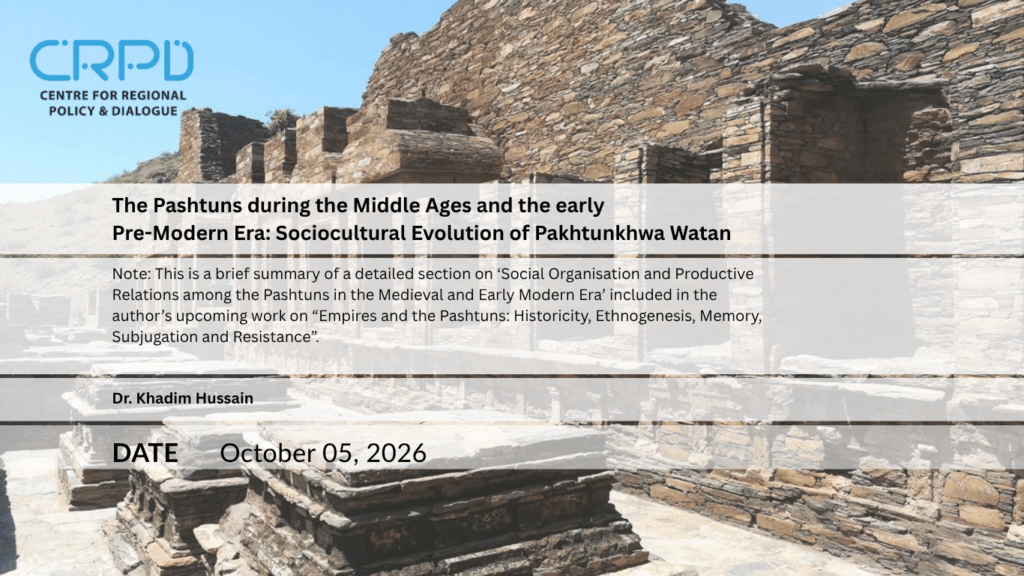
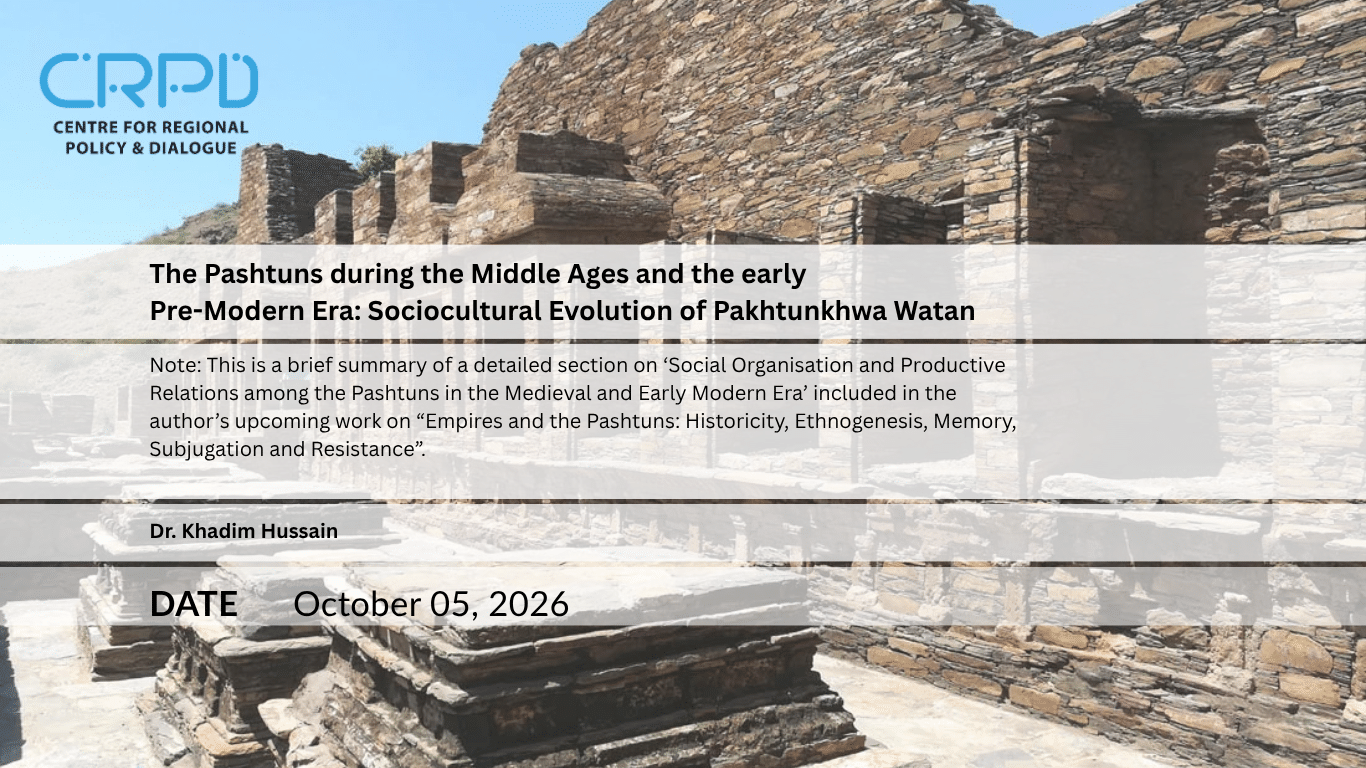
Note: This is a brief summary of a detailed section on ‘Social Organisation and Productive Relations among the Pashtuns in the Medieval and Early Modern Era’ included in the author’s upcoming work on “Empires and the Pashtuns: Historicity, Ethnogenesis, Memory, Subjugation and Resistance”.
The writer is Director Research and Publications at the Centre for Regional Policy & Dialogue (CRPD) Islamabad, and can be accessed via khadimhussainpajwak@gmail.com