By Dr. Fazli Malik
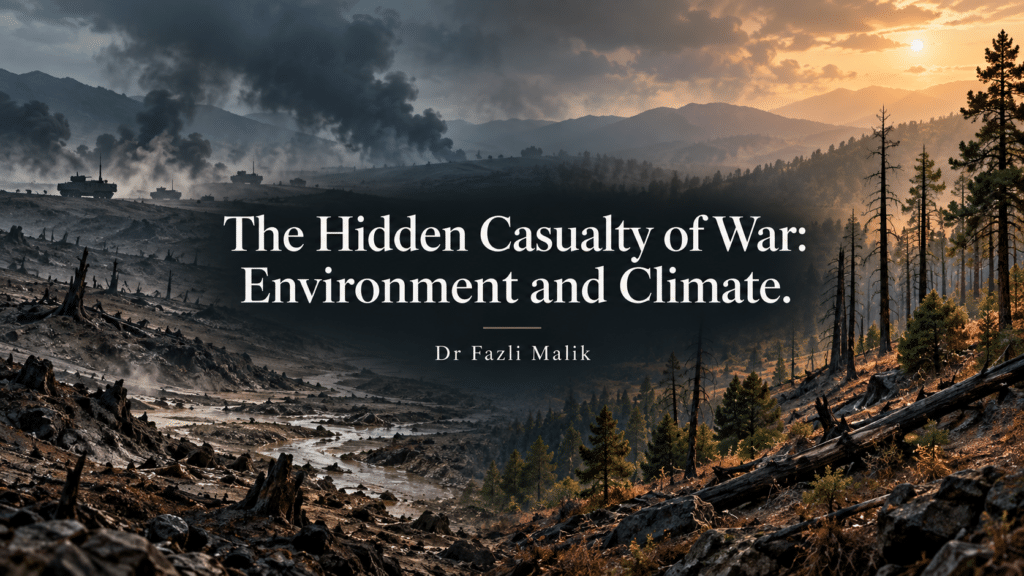
World militaries operate in complex ways as they have unique supply chains. They mostly rely heavily on fossil fuels for their routine activities and operations. The United Nations Framework Convention on Climate Change (UNFCCC) Global Stock calculates their emissions, excluding war fighting, are 5.5% of the total global Green House Gas (GHG) emissions, ranking just after the third top emitter, India. Yet the emissions from these activities have no registry to record them. So far, military-related greenhouse gas emissions have attracted very little attention worldwide. Even the UNFCCC has left this huge emission unaccounted. There seems to be no compulsion on the member states for the submission of military-related emission reports.
Reports state that war-related activities in Afghanistan, Iraq, Pakistan, and Syria produced an estimated 440 million tons of CO2eq during 2001–2018. The first seven months of the Russia-Ukraine war alone produced an estimated 100 million tCO2 eq. These wars carry long-lasting implications for local flora and fauna — from bees to sea animals, and from algae to pine trees.
The Middle East: A New and More Carbon-Intensive War.
The US/Israel—Iran conflict in the Middle East erupted in February 2026 resulting in a combined attack by Israel and America on Iran and met by an Iranian counter-attack on Israel and the US allies in the Middle East. Apart from casualties and infrastructure damage, the implications of this prolonged war for the environment and climate are disastrous. So far this war has proven to be the most CO2e-intensive conflict, and has largely disturbed the already stressed carbon budget making the global climate targets harder to be achieved.
The American Central Command (US CENTCOM) has claimed that attack on Iran (Operation Epic Fury) is the biggest ever US military power show since decades. It has further stated that the US-Israel combined attacks on Iran have used 20 different types of war systems including aircrafts, drones, ships, missiles, etc., over around 1000 targets in Iran.
Initial analysis by the Climate Community Institute estimated that 5 million tons of CO2e greenhouse gases were emitted in just the first two weeks of the war which is higher than the annual emissions of most of the countries in the world. Further breakdown of the total emissions highlighted that a large portion i.e. 1.8 million tCO2eq emissions came from Israel’s attacks on fuel storage depots alone. Other sources of emissions are fuel fires, building destruction, military and equipment transportation, and combat aircraft activities. Moreover, the loss of ships and aircraft in combat, along with the excessive use of munitions, added more to the already substantial CO2eq output. These huge war emissions in only a few days are higher than the annual emission of many countries of the world highlighting the stark climatic impacts of modern-day warfare. To prevent further damage, it is high time that war related emissions are brought under global climate accountability frameworks.
Poisoned Air, Water, and Soil.
War generates pollution that affects soil, sea, forest and the life these ecosystems sustain. Bombing fuel depots, oil and gas tankers, and banging buildings and industrial sites releases soot, smoke, oil particulates, heavy metals, and sulfur compounds into the air, land and water ultimately affecting both terrestrial and marine ecosystems alike.
The Conflict and Environment Observatory has reported that out of the initial 300 recorded strikes, some 232 posed significant environmental threats. A satellite tracking analysis of aerial bombardment by the Observatory shows that airstrikes damaging urban infrastructure create hazardous material, alongside the risk of unexploded munitions and heavy metals released from weapons use.
Tehran is already declared as one of the most polluted cities in the world which has received tons of additional polluted particles during continuous bombardment. The Iranian Minister for Health, in his interview to an international news channel, confirmed that pollutants from the bombing and fires have begun contaminating the soil and water that posed dire consequences for the people and agriculture in the areas surrounding Tehran. Dr. Tedros Adhanom Ghebreyesus, Director General of the World Health Organization, has also expressed concern over attacks on energy facilities, particularly petroleum infrastructure.
Compounding the problem, a low-pressure weather system that regularly crosses the skies of Iran makes conditions favorable for precipitation. Consequently, Sulfur and Nitrogen produced by oil fires dissolve in rainwater making them more acidic than normal. Dr Akshay Deoras, an environmental scientist at the University of Reading, states that the rainfall observed over Tehran right after the initial bombardment was, in fact, a liquid mixture of toxic particulate matter. Rainwater follows its natural pattern and impacts both soil and crops, and dilutes in water systems ultimately entering in the food chains.
The War’s environmental damage is not confined to land only, the liquefied gas and oil-carrying ships travelling through the Hermes Sea route also come under continuous attacks resulting in millions of barrels of oil and liquid gas spilled into the sea. The environmental groups have warned of irreparable consequences for the aquatic life. If war activities continue in the open sea, this would turn the sea almost uninhabitable.
War did not stop at attacking the energy facilities. More alarmingly, both parties in the war began striking nuclear facilities. Iran reported an attack by the Israel army on the Dimona nuclear facility, followed by counter-strikes by the Iranian Revolutionary Guard on an Israel nuclear facility. Although the International Atomic Energy Agency (IAEA) has confirmed no radiation leakage from any nuclear facility in either country so far, however, any future attack would pose a disastrous radiological threat to regional public health.
The environmental and climatic impacts do not end with the termination of war. These impacts will remain with us for decades shaping our health and livelihood for a long time. This requires our attention more than ever so that the already fragile planet is protected and passed on to the next generation in a livable shape.
| The author is an expert in climate change and disaster management and can be reached at fazlimalik12@yahoo.com |