Democracy is often rejected in some conservative political circles as a Western concept, even though its fundamental principles are deeply rooted in indigenous and grassroots understanding of collective governance, consultation, representation, and public participation. In Pashto, the idea of Ulasi Hakumat and Ashar—government by and for the people—captures much of the democratic spirit without relying on foreign terminology. This reflection draws on political discussions in several parts of Khyber Pakhtunkhwa including a discussion session in Wana, South Waziristan, to illustrate how familiar concepts and practical experiences can help promote a clearer understanding of democracy, political participation, shared governance and respect for differing viewpoints.
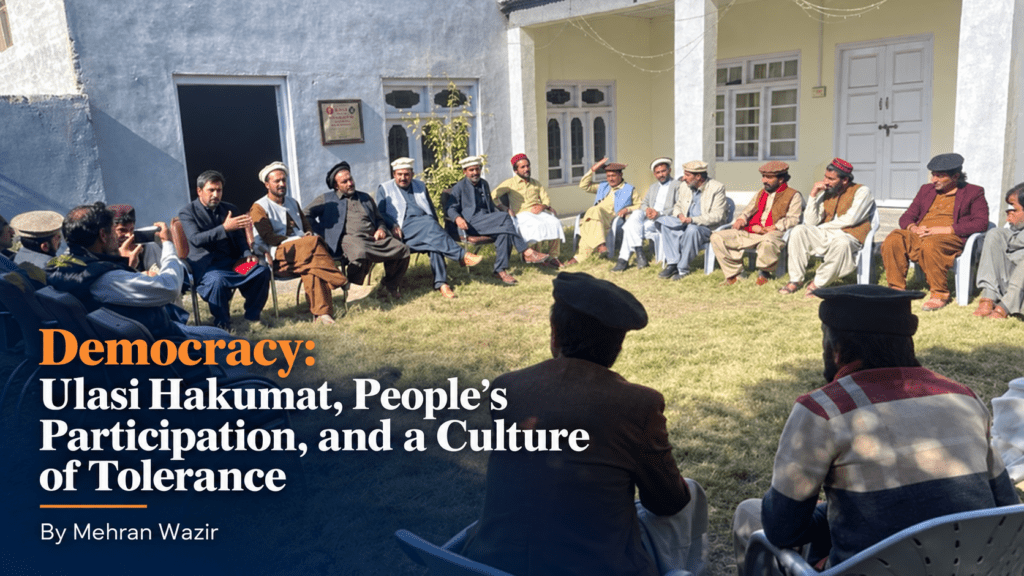
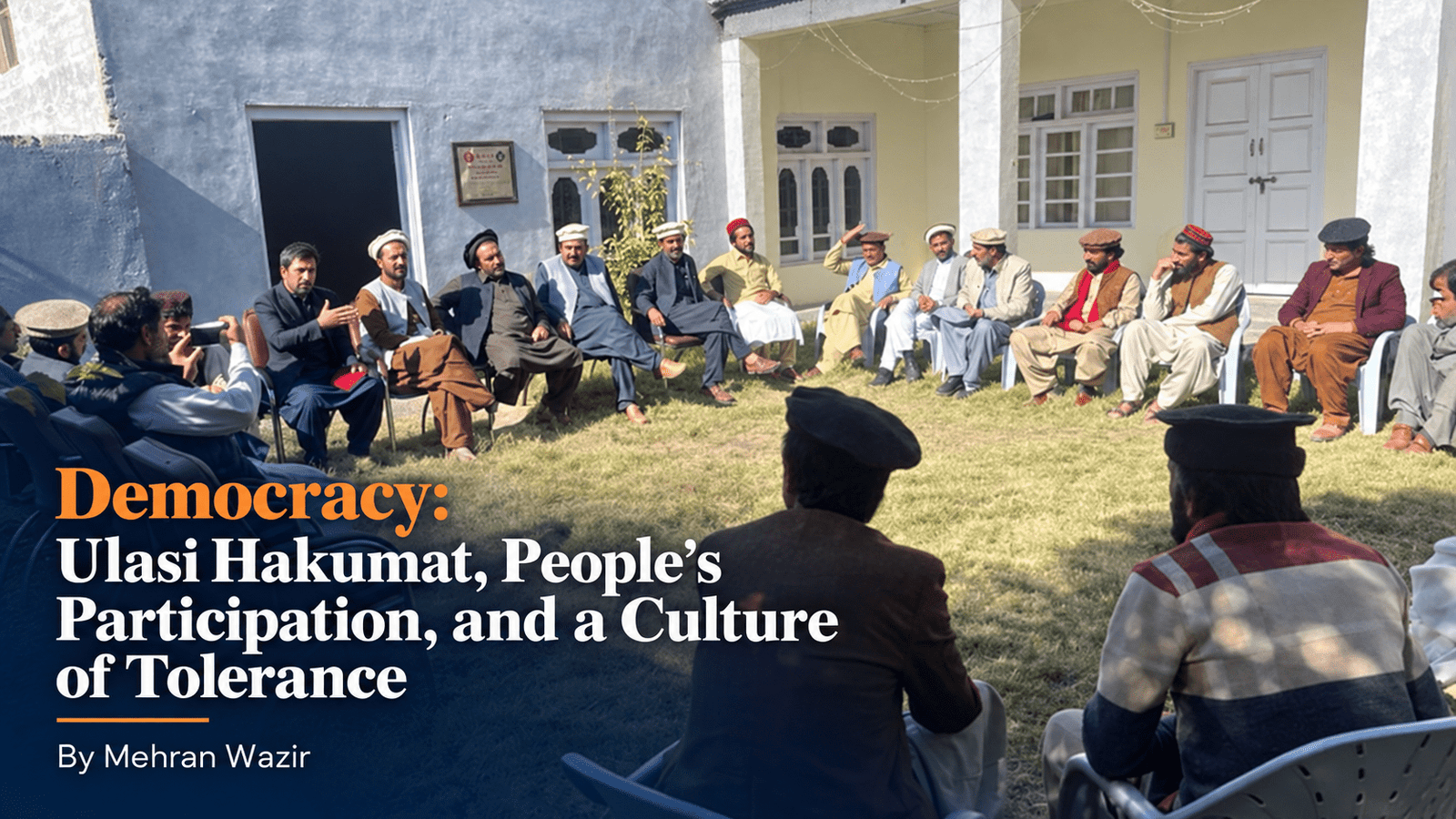
It was a warm and pleasant afternoon in the courtyard of the Wana Press Club. The club’s president and secretary were sitting together quietly discussing the situation in Waziristan when I arrived to confirm whether the conference hall had been prepared for our meeting with the Wana Siyasi Ittehad, or Wana Political Parties’ Alliance. They welcomed me warmly, offered tea, and invited me to join them in the sunshine while assuring me that all the arrangements had been completed.
Representatives of different political parties gradually began to arrive. Once everyone had settled, I proposed that we should move into the conference hall to begin the meeting. The participants, however, preferred the relaxed and open atmosphere of the courtyard. Consequently, the discussion commenced there under the open sky.
As the meeting progressed, representatives from nearly all the registered political parties in Waziristan shared their observations and reflections. They appreciated the initiative and discussed the importance of political participation, cooperation, and dialogue in the region. During the discussion, a representative of Jamaat-e-Islami, who was also a member of the Wana Political Parties’ Alliance, stated that his party did not support democracy because it regarded both the term and the concept as Western.
Rather than treating his position as an affront, I saw it as an opportunity to clarify the principles underlying democracy. I acknowledged that his party’s ideological position might prevent it from openly endorsing the term. However, I drew attention to the apparent contradiction between rejecting democracy and participating in a political alliance composed of diverse parties. He justified his party’s participation on the ground that the alliance was effective.
This acknowledgement became an important point of departure for the discussion. The alliance was effective precisely because people with different political and ideological backgrounds were willing to come together, listen to one another, and cooperate on matters of shared concern. Such cooperation created space for shared interests, objectivity, consultation, and collective engagement within social and political processes. These features are essentials of democratic values; rather, they represented some of the most important foundations of democracy.
The discussion then shifted from the contested term “democracy” to the locally understood concept of Ulasi Hakumat. In Pashto, ulasi refers to the people in an organized and collective sense, while hakumat means government. The representative of the conservative party readily supported the principle of Ulasi Hakumat. He also agreed that people should be able to participate in social and political processes without unnecessary restrictions and without violations of their fundamental rights. Furthermore, he accepted that a government should represent the people and reflect their collective will.
His agreement with these principles demonstrated that the disagreement was largely related to terminology rather than substance. Ulasi Hakumat, meaningful public participation, representative government, fundamental rights, and respect for diverse political opinions are all fundamental elements of democratic life. These principles are also essential to the social and political well-being of the people of Waziristan and the wider region.
Although the representative proposed continuing the discussion through a public debate at another time, changing his ideological position was not the central purpose of the exchange. The broader audience was equally important, particularly those participants who might otherwise be influenced by arguments portraying democracy solely as a foreign or Western imposition. By relating democracy to familiar ideas such as Ulasi Hakumat, collective consultation, political representation, and public participation, the discussion offered an alternative framework through which participants could understand and defend democratic values. The most encouraging response came from several young social and political activists after the meeting. They explained that the discussion had helped them develop clearer and stronger arguments in support of their work for peace, respect for diversity, public participation, and democracy. Their response affirmed the value of creating open spaces where contested ideas can be examined through accommodative dialogue and connected to the lived political experiences of local communities.