Khadim Hussain
16 Jan 2026
This might be considered a cliché to assert that a vital area such as education system in Pakistan has remained neglected in terms of financial allocations. Public education in Pakistan has been a field of consistent experimentation in terms of system and structure and an arena for constant contestation in terms of generating and permeating historical, sociocultural, sociopolitical and socioeconomic discourses. Education in Pakistan, it appears, has been effectively used as a tool for constructing a narrative of ‘a single nation’ in a region inhabited by diverse ethnonational, cultural, lingual and religious identities instead of inculcating critical, creative and imaginative nurturing of young generations. Needless to emphasise that education in Pakistan has been used as a vehicle for controlling discursive infrastructure and for constructing a centralised narrative.
Starting from the first education conference right after the inception of Pakistan in 1947, dozens of country level conferences and scores of educational policies tell a story of missed opportunities and subtle subversions. The epistemic subversion took a drastic turn during the military rule of Zia-ul-Haq in the decade of 1980s when “the charge of Islamising education was given to a religio-political party which assumed full control over the entire spectrum of education; from designing a new school curriculum to writing textbooks, managing assessment system, and managing education departments, etc.” (Nayyar, 2025: 25). The series of epistemic subversions took a new turn when the extremely controversial Single National Curriculum (SNC) was enforced in 2019 by the Pakistan Tehreek-i-Insaf (PTI) federal government which was renamed as National Curriculum of Pakistan (NCP), but resumed, by the interim government of Pakistan Democratic Movement (PDM), mainly consisting of Pakistan Muslim League-Nawaz (PML-N), Pakistan People’s Party (PPP) and Jamiat-i-Ulamai Islam-Fazal (JUI-F).
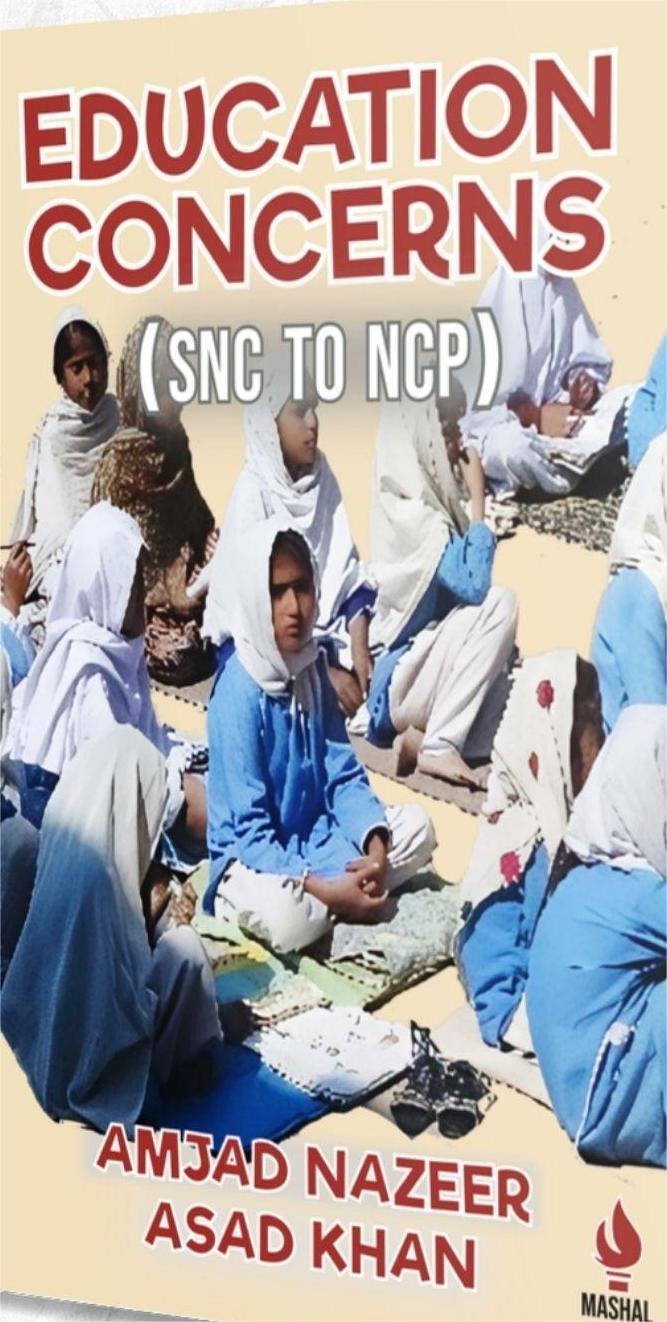
The book by Amjad Nazeer and Asad Khan entitled Education Concerns (SNC to NCP), published last year (2025) by Mashal Books, Lahore, is an empirically grounded and theoretically aligned diagnostic analysis of the latest epistemic subversion of the education system in Pakistan. The authors are well-known in the civil society landscape, human rights struggle and academic circles of Pakistan and have all the requisite research and scholarly credentials to carry out an objective study of the Single National Curriculum, renamed as National Curriculum of Pakistan. The book in its nine chapters and 235 pages has attempted to comprehensively cover significant aspects of the Single National Curriculum such as constitutionality of the Single National Curriculum, content analysis of the Model Textbooks developed under the Single National Curriculum and continued in the National Curriculum of Pakistan later, implementation of the curriculum in the three major streams of education—public schools, private schools and Madrassas—, pedagogical landscape like teachers’ training programmes, assessment system under the Single National Curriculum, job market, and most importantly, financing of the education system in Pakistan. The book has been foreworded by eminent educationists of the country, Dr. A. H. Nayyar and Dr. Naazir Mahmood. A reader may easily deduce the discourse, intent, and impacts of the Single National Curriculum after going through this empirical study that contains robust data and carries incisive analysis.
The book starts with an elaborate discussion on the methodology of the study that enlightens a reader about the focus and scope of the study. Current authentic statistics, mostly tabulated by the Education Statistics of Pakistan brought out by the Pakistan Institute of Education, about the educational landscape of Pakistan. The statistics bring to light a bleak picture and dismal condition of the education system of Pakistan in the context of the Sustainable Development Goal-4 “which obliged the states to provide at least 12 years of children’s schooling, and 25-A of the Constitution of Pakistan committing Universal Primary Education”. With 26.2 million of school-going age children out of schools, “Pakistan constitutes the second highest number of out of schools’ children in the world after Nigeria having one of the largest primary-school drop-out ratios in the world which stands around 41% (40% for boys and 42% for girls)”.
According to Education Statistics of Pakistan tabulated by the Pakistan Institute of Education in 2021-2022, around 11.7 million were out of schools in Punjab, 3.63 million children were out of schools in Khyber Pakhtunkhwa, 3.13 million children were out of schools in Balochistan, 7.63 children were out of schools in Sindh and 0.08 children were out of schools in the Islamabad Capital Territory. The average teacher-student ratio stood at 1:40 in 2021-2022. An average of 1.8% of GDP is allocated for education in Pakistan, far less than the United Nations recommended 4-6% of GDP to be allocated for education. At least 35,000 new schools in Punjab, 25,000 new schools in Sindh, 15,000 new schools in Khyber Pakhtunkhwa and 10,000 new schools in Balochistan will be needed in the coming decade to put all the out of school children at schools. The Annual Status of Education Reports (ASER) and Science, Technology, English and Mathematics Reports (STEM) present a dark picture regarding the skill level and other quality indicators of education in Pakistan. Basic facilities at public schools in Pakistan such as sanitation, potable water, electricity, class rooms, libraries and laboratories also present a gloomy picture.
The study points out that instead of prioritising more financial allocations for education to meet the needs of students and teachers and for putting out of school children at schools and instead of taking drastic measures to upgrade quality of education, the PTI government came up with yet another cosmetic scheme called as the Single National Curriculum. This scheme was premised on the populist slogan of bringing an end to educational apartheid and design a ‘Uniformed Schools Education’ to transform the class-based education in Pakistan. The proponents of the Single National Curriculum in the Federal Government of Pakistan, the Provincial Government of Punjab, the Provincial Government of Khyber Pakhtunkhwa and in the National Curriculum Council claimed that they had consulted some 400 experts for devising the framework and Model Textbooks of the Single National Curriculum. The authors have raised some incisive questions on this count. What happened to the original idea of introducing a Uniformed School Education? If the syllabus is more or less the same as in 2006 (save certain insertions and omissions), then what was the whole euphoria all about? Why was such a strategic subject of education presented more as political action than as an act of academic serenity? Why were the names of the experts and stakeholders consulted not made public? Did they genuinely and meaningfully represent multiple spheres of life and education? Was any report produced as an outcome of the consultation and if it was, why was it not circulated widely? Why was Single National Curriculum trumpeted as a revolutionary step? The authors conclude that “the truth is that the Single National Curriculum failed to reach a consensus and the so-called wider consultation was nothing more than a political gimmick to seek political legitimacy of the regime”.
In fact, the Single National Curriculum was not only meant to seek legitimacy for the regime but was also intended to strike at the fundamental structural core of the constitution of Pakistan. The Constitution of Pakistan is underpinned by three fundamental systemic pillars—democracy, federal parliamentary system and fundamental citizenship rights. The 18th Constitutional Amendment enacted by Pakistan’s parliament in 2010 had restored the federalist core in the 1973 Constitution of Pakistan after several years of distortions brought about by the successive miliary regimes in the country. The 18th Constitutional Amendment has devolved administrative authority of some 17 ministries to federal units (provinces) through abolishing the concurrent list of the constitution, ensured fiscal federalism through a mandatory National Finance Commission, expanded the scope of fundamental rights and strengthened democratic structures through creating impediments to supra-constitutional interventions. Administrative, financial and political decentralisation through the 18th Constitutional Amendment has reconstituted the centre-provinces and inter-provincial relationship that might have led to stable federal political structure in Pakistan. Educational planning, curriculum and governance are devolved to the provinces after the 18th Constitutional Amendment as “the landmark amendment imparts provinces with strong legislative and financial autonomy inclusive of weighty implications for the overall system of education”.
Designing the Single National Curriculum at the federal level appeared to have aimed at breaking into the constitutional guarantees for provincial autonomy. The then provincial education minister of Sindh was of the view that “by introducing the Single National Curriculum, the Federal Government breached rights of the provinces that they are entitled to constitutionally”. He had further elaborated that “the Single National Curriculum is a part of the ruling party’s manifesto and not a constitutional provision” while the Chief Minister of Sindh had termed the Single National Curriculum as a ‘Trojan Horse’ breaking into the provincial autonomy.
A multiparty and civil society conference (Pashtun Qaumi Jirga) on 10 March 2020 at Bacha Khan Markaz, Peshawar, attended by representatives of almost all political parties of Khyber Pakhtunkhwa, and representatives of multiple academic, media and human rights forums working in Khyber Pakhtunkhwa, had unequivocally and unanimously rejected the Single National Curriculum and considered it a brazen attack on provincial autonomy. The Balochistan government, on the other hand, tried to seek a middle ground. It had not outrightly rejected the Single National Curriculum but had raised pertinent points to question the content of the Single National Curriculum. Reservations of Balochistan included “ignoring the fundamental barriers to better education, i-e., missing teachers and missing facilities, teachers’ incompetence to teach the new curriculum, the proposed curriculum’s limited relevance to Balochistan’s socio-cultural and historical context, advanced and extended essays and exercises, heavy Islamic content (within and outside Islamiyat), undermining Balochi, Pashto and Brahui languages and most importantly the budgetary constraints, etc.”
One of the most important aspects of the study by Amjad Nazeer and Asad Khan is critical analysis of the content enshrined in the textbooks and Model Textbooks developed under the system of Single the National Curriculum. The study takes up five important layers of the content and their implications for the primary and secondary students of Pakistan in the subjects of social sciences, languages, natural sciences and Islamiyat. The five layers include cognitive development, and lack thereof, of critical, creative and logical reasoning among students, hero construction in textbooks, accommodation of ethnocultural diversity, gender representation and inclusion of minority faith denominations in the textbooks.
The study concludes that mostly historical war heroes and those “from the armed forces, law enforcing, and civil departments” have been constructed as heroes “whereas those prominent personalities have been ignored who strove for peace, democracy, equality, civic rights and social justice”. The ‘knowledge and skills component’ unit of the History textbooks of Grade V to Grade VIII has been maneuvered to “justify that as the people of the Indus Valley did not learn the art of warfare, nor did they develop their trade, therefore, they were easily defeated by the Aryans”. The authors’ comment on the objective of this unit is worth quoting: “possessing a poorer warfare technology as a justification for defeat and extinction is historically incorrect. Kingdoms and empires of the past with an ambitious defence system have also crumbled down for various reasons. Justifying war and weaponry contradicts the value of peace and diplomacy”.
The study also highlights that little effort in the textbooks has been made to undertake cognitive development of critical and creative thinking and logical reasoning. The authors are of the view that “both English and Urdu language subjects in the Single National Curriculum-prescribed textbooks are generally devoid of interest and curiosity. Most of the essays—save certain stories and poems—are written by one particular author and edited cum supervised by a group of National Curriculum Council-approved authors. They are plain, monotonous and driven by the so-called moral lessons (naseehat amoz kahanian aur mazameen). No surprise that neither the authors nor the supervisors are recognised literary figures”. The authors, in this regard, have quoted former chairman Higher Education Commission of Pakistan, Tariq Banuri, as saying that “refuting all its claims, the Single National Curriculum is going to further confuse our education system in the country. Another generation risks not being able to question their learning as it has become an insidious problem. Instead of encouraging creativity and critical thinking, it is the same old stuff that we have seen for the past several years. With this curriculum, free-thinking and innovation is highly unlikely to come by. Under the garb of ‘one nation, one curriculum’, the privileged students, once again, are going to offset the conservative teaching, and the disadvantaged students will continue to suffer as ever before”.
While carrying out content analysis of the compulsory English subject of Grade VI-VIII, the authors have pointed out that only one theme is dedicated to cultural diversity having a marginal share of 5% in the overall content. This concurs with the discourse of the Nation Building project generated by the ruling elite of the country right at the inception of Pakistan. Instead of recognising the sociocultural reality of lingual, cultural and ethnonational diversity, considered as invaluable richness, the ruling elite embarked on the project of forced homogenisation that led to more conflicts and fissures within the Pakistani diverse social landscape.
The knack for artificial homogenisation, demonstrated through “one nation, one religion, one language, one culture, one identity and one curriculum”, appears to be aimed at denying equitable representation in political governance and equitable share in resources to diverse groups of citizenries in the country. This has inevitably led to centralisation of power and resources and has caused marginalisation and class-based social organisation. The centralisation of power and resources has been effectively camouflaged in the inculcation of “patriotism, glorifying armed forces and Islamic ideology” in the educational curricula developed under the Single National Curriculum. In the History curricula, “the topics of Aryans, Kushans, and Guptas in Grade VI, and Ashoka’s transition from a warrior king to a preacher of peace and humanity might have been a great example to inspire students to adopt the values of peace and tolerance. Ashoka’s pacificism and edicts, hidden in the plain sight in the present-day Khyber Pakhtunkhwa, can exemplify the ancient and middle period’s preference for people’s welfare over military pursuits”.
The authors of Education Concerns (SNC to NCP) have carried out meticulous analysis of gender representation and patriarchal perpetuation in the textbooks and Model Textbooks developed under the Single National Curriculum asserting that “60% of the Model Textbooks portray men/boys as delivering societal functions while only 39% of women/girls are observed playing those functions”. Undertaking further breakdown, the authors have found out that “out of 668 pages of English books, 58% are men/boys and 42% are women/girls” while in 672 pages of Mathematics, 51% of the books portray men and 49% portray women in different capacities”. Furthermore, in five of the Urdu books comprising 791 pages, there is about 60% of men/boys in comparison to 40% of women/girls”.
The authors have observed that 58% of women/girls represented in the textbooks are seen wearing Hijab (cover) while in 41% of the pictures, they are not wearing Hijab. The authors are of the view that “the message communicated by Hijab or portrayal of women/girls is the same as uttered by the then prime minister Imran Khan more than once that the dress code had a lot to do with violence against women, and the same mindset was reflected in the Single National Curriculum’s imagery”. The authors have also highlighted the important aspect of power distribution in gender discourses while analysing gender representation in the Single National Curriculum. They are of the view that “the Single National Curriculum books paint more men in positions of power than women. Women are mostly shown as home makers or in subordinate positions”.
While carrying out content analysis of the textbooks developed under the Single National Curriculum, the authors have found out another extremely devastating faultline in the syllabi. Faith-based education has remained a subject of severe contestation in Pakistan and some other countries of the world but “it is universally recognised that teaching and learning of faith should either be parental or personal choice and must not be instructed or enforced by state institutions. If at all, it should be non-discriminatory, non-sectarian and minimal in scope and content”. Keep in view these universal parameters, “technically, teaching of Islamic faith is an instructional subject that should be part of Islamiyat only”, in which case, non-Muslim students must be provided with the choice to learn about their own faiths. At least this is what Article 22(1) of the Constitution of Pakistan implies when it states that “no person in an educational institution can be forced to receive religious instruction, attend ceremonies, or worship for a religion other than their own”.
In the case of the textbooks developed under the Single National Curriculum renamed as National Curriculum of Pakistan, the content of the dominant faith (read Islamic education) has not only been incorporated in the compulsory subject of Islamiyat, it has also been inserted widely in syllabi of social sciences, languages and even in the subjects of natural sciences which is a clear violation of Article 22(1) of the constitution of Pakistan. Even the politics of All India National Congress and All India Muslim League during partition of the subcontinent has been framed in the textbooks on history and social sciences as friction between Hindus and Muslims which is an outright distortion of history. Perhaps no hero from the minority faiths has been included in the social science and languages subjects developed under the Single National Curriculum. Quoting eminent educationist, Dr. A. H. Nayyar, from the foreword of the Education Concerns might not be out of place here. Dr. Nayyar is of the view that “Pakistan’s public education is a severely starved sector, being allocated a mere 2% of the Gross Domestic Product (GDP). The promised uniform education system would have required at least two three times as many resources. Since that was not possible, and since something cheap needed to be done, the result therefore is the Single National Curriculum (SNC). And what has come out as SNC is in essence madrassisation of schools. No school curriculum in Pakistan’s 75-year history had as much religious content as SNC. Some of its architects may take pride in this achievement, but they have no idea how much harm their product is going to inflict on the future of the nation”.
Instead of bringing an end to the gender, rural-urban and provincial inequalities in the education system of Pakistan; instead of devoting more resources as compared to the current meagre allocations for education in Pakistan; instead of focusing on upgrading pedagogical strategies through robust teachers’ training programmes; instead of updating curricula to include arts, environmental studies, peace education, and modern technologies, and instead of overhauling assessment of education system to inculcate critical, creative and innovative faculties of students, the Imran Khan-led PTI federal government embarked on the Single National Curriculum that is constitutionally damaging for the fundamental federalist pillar of the social contract in Pakistan, that is academically flawed and that has been awkwardly implemented. The current PML-N government has just renamed the project as National Curriculum of Pakistan aimed at reversing provincial autonomy and devolution of power, while continuing with the same poisonous SNC. This is just presenting old wine in the new bottle.
References
Nayyar, A.H. (2025). A Dive into the Education Landscape of Pakistan. The Cecil & Iris Foundation (CICF). Lahore.
(The writer is Director Research & Publication at the Centre for Regional Policy and Dialogue (CRPD))