By Mehran Wazir
24 February 2026
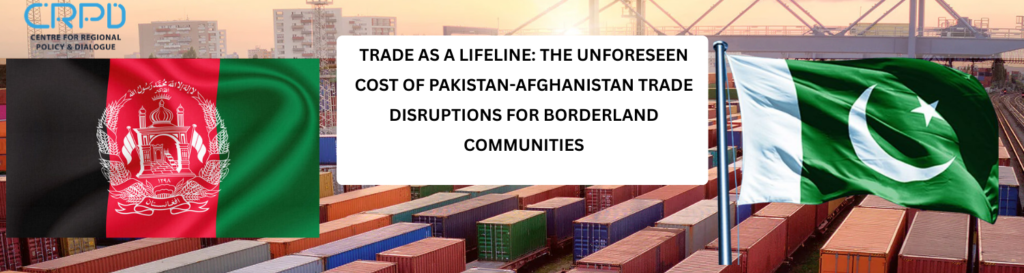
Trade is usually discussed in terms of strategy, leverage, and geopolitical interests but for most countries in the world, and especially borderland communities, trade is not a strategic instrument to be used for political influence across the border, it is their lifeline. Nowhere is this reality more visible than along both sides of Durand Line, where repeated trade disruptions, closure of trade routes, and policy inconsistencies have inflicted deep and lasting damage on livelihoods, economic institutions, and regional stability.
Over the past several years, trade across the Durand Line crossing points has frequently suffered setbacks due to abrupt border closures, restrictive regulations, and shifting political priorities. These disruptions have resulted in billions of dollars in cumulative losses which have been observed not only in the weakened bilateral relations but also in the absence of a consistent and predictable regional policy toward neighbouring countries.
The frequent change in priorities, often driven by short-term security or geopolitical considerations, undermines long-term economic planning and subverts advantages of integration. Trade cannot flourish in an environment where policies change overnight and where border closures become routine rather than exception. While federal-level discussions often focus on diplomatic signalling, the borderlands face immediate shock becoming the first and the most severe victims of any disruption.
According to a report titled Pakistan-Afghanistan Trade Disruptions: At What Cost to Livelihoods and Regional Stability? published by the Centre for Research & Security Studies (CRSS), Pakistan exports approximately USD 1.5 billion worth of goods to Afghanistan annually. A three-month disruption alone resulted in losses of around USD 375 million for Pakistani exporters. The same three months disruption, additionally, caused heavy set back to the export of goods and caused losses to the tune of USD 225 million of the nearly USD 900 million which are exported each year through Afghanistan to Central Asia. Afghanistan, too, paid a heavy price. During the same period, it lost approximately USD 200 million in exports to Pakistan and USD 75 million in exports to India via the Wagah border.
These figures are alarming but statistics alone cannot explain the full implications of trade disruption. The social world of the borderland tells a far more complex story, one rooted in social relations, informal economies, trust networks, and historically evolved partnerships that cannot be easily quantified. Cross border trade disruption triggers a cascade of economic and social consequences that extend far beyond immediate financial loss in the borderland regions.
Repeated closures weaken and eventually destroy physical infrastructure linked to trade including transport networks, storage facilities, loading points, and customs-related services. Once disrupted, these systems are not easily restored, especially in marginalised border regions which attract minimal state investment and which suffer from a prolonged violent conflict between security forces and the Armed Non-state Actors.
The trade-related institutions suffer deeply at the same level. Trade unions and associations, which were once locally rooted and were representative, are often replaced by unrepresentative and mysterious bodies that are pampered at the cost of representative bodies. In some cases, these unrepresentative unions are instrumentalised for strategic or security purposes rather than economic facilitation which further complicate the situation in the borderlands.
Equally damaging is the erosion of individual trust as economic capital. Trust-built over decades among traders, transporters, and customs intermediaries, is replaced by fear and uncertainty. The growing influence of a few individuals closely aligned to the non-trade strategic objectives further damage the trust among traders across the border. This shift distorts market dynamics and marginalises genuine traders. Small traders, typically operating through interlinked chains rather than isolated trade landscape, are particularly vulnerable. When one link breaks, the entire chain collapses.
Cross-border partnerships continue to be threatened due to trade disruptions. Traditionally, Afghan and Pakistani traders operated through joint arrangements where one partner managed trade affairs inside Afghanistan and the other handled matters in Pakistan. These partnerships have been broken in two major ways. First, prolonged border closures for trade and crackdowns on Afghan nationals in Pakistan and subsequent repatriation, have created legal and communication issues between citizens of the two countries. Second, border-trade-dependent bazaars and marketplaces near crossing points have suffered enormously. Disruptions break supply chains, reduce footfall, and push once-thriving commercial centres toward decline or abandonment.
As border economies weaken, economic activity shifts toward the urban centres. This migration drains border regions of capital, labour, and entrepreneurial energy, further deepening regional inequality. Transport workers, warehouse labourers, food vendors, mechanics, and service providers, many of whom depend indirectly on cross-border trade, also lose their livelihoods. The impact, therefore, extends far beyond traders alone.
Addressing these challenges requires moving beyond securitized and short-term approaches to border management.
People-to-people Dialogue
Sustained, gender-inclusive dialogue among civil society members, social and political activists, academics, trade unions, market associations, and students is essential. Such dialogue can help rebuild trust, humanize border issues, and generate locally informed solutions for trade and mobility.
Engaging Political Leadership
Members and leaders of political parties, particularly Pashtun nationalist parties, with deep roots in borderlands, should take the lead in initiating dialogue with the Afghan Taliban on trade facilitation and border crossings for ordinary people. Trade must be treated as a shared economic necessity, not a bargaining chip.
Independent Research
An independent and comprehensive study should be conducted to identify opportunities, risks, and challenges related to border trade. Such research must prioritize borderland perspectives and inform long-term, consistent policy frameworks.
Trade along the Durand line is not merely about exports and imports, it is about livelihoods, trust, social stability, and regional peace. When trade is disrupted, borderlands bleed first and longest. Any sustainable policy must recognize that economic lifelines cannot be governed solely through strategic impulses. Stability in the region depends on keeping these lifelines open, predictable, and rooted in social realities of people in the borderland.
The writer is an author, analyst, and researcher based in Islamabad. Mehran Wazir is the Chief Executive Officer at the Centre for Regional Policy & Dialogue (CRPD). He can be contacted at mehran.waziri@gmail.com.