Green Energy Jirga
Article 9-A of Pakistan’s Constitution recognizes a clean and sustainable environment as a fundamental right, underscoring the state’s obligation to pursue climate-responsive development pathways aligned with decarbonization, net-zero commitments, and the Sustainable Development Goals (SDGs). In Pakhtunkhwa, where climate vulnerability intersects with development pressures, the need for environmentally sound and socially inclusive energy policy has become increasingly urgent. While the province is endowed with rich natural resources—particularly extensive river systems—energy planning must balance utilization with ecological protection, community livelihoods, and long-term climate resilience.
Pakhtunkhwa’s energy strategy has historically prioritized large and medium-scale hydropower development, with multiple projects planned, completed, or under construction under the auspices of provincial institutions and multilateral development banks. Although these investments have expanded generation capacity, they have also generated significant social, environmental, and governance challenges, including land acquisition disputes, ecological degradation, impacts on tourism-based economies, and persistent delays and cost overruns. At the same time, this sustained emphasis on hydropower has constrained the policy space and public momentum required for scaling up solar energy, despite its suitability for decentralized, climate-friendly, and community-level solutions.
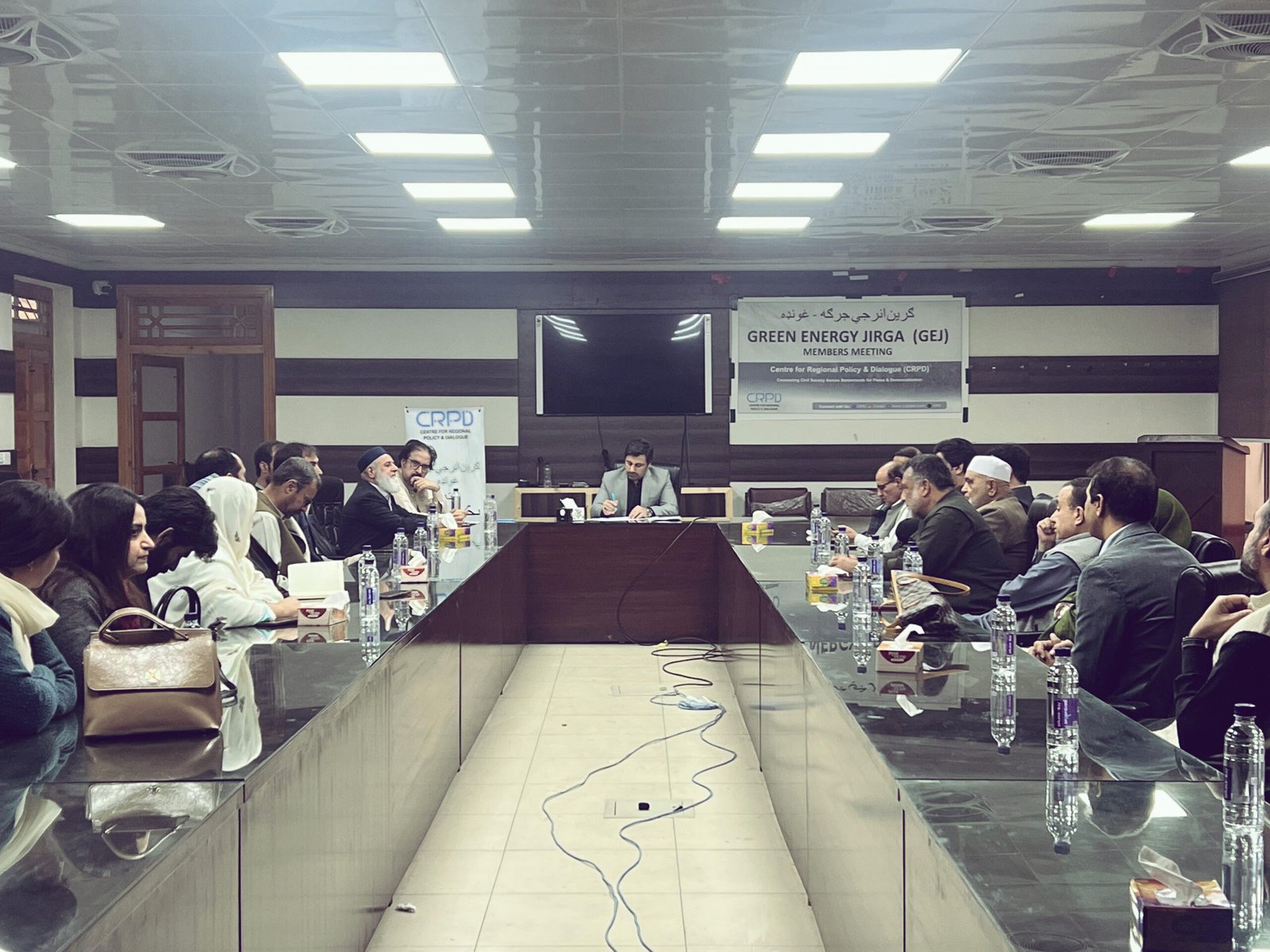
In response to these dynamics, the Centre for Regional Policy & Dialogue (CRPD) has initiated the Green Energy Jirga (GEJ) as a civil society–led platform to strengthen public demand for a balanced and climate-resilient energy transition, with a particular focus on accelerating solar adoption. By convening legislators, civil society organizations, activists, and technical experts, the GEJ seeks to foster informed public dialogue, support evidence-based policymaking, and build broad-based ownership of clean energy solutions. Grounded in advocacy rather than confrontation, the initiative aims to complement existing energy pathways while enabling a more diversified, inclusive, and sustainable energy future for Pakhtunkhwa.