Healing through Goddess of the Indus
Khadim Hussain
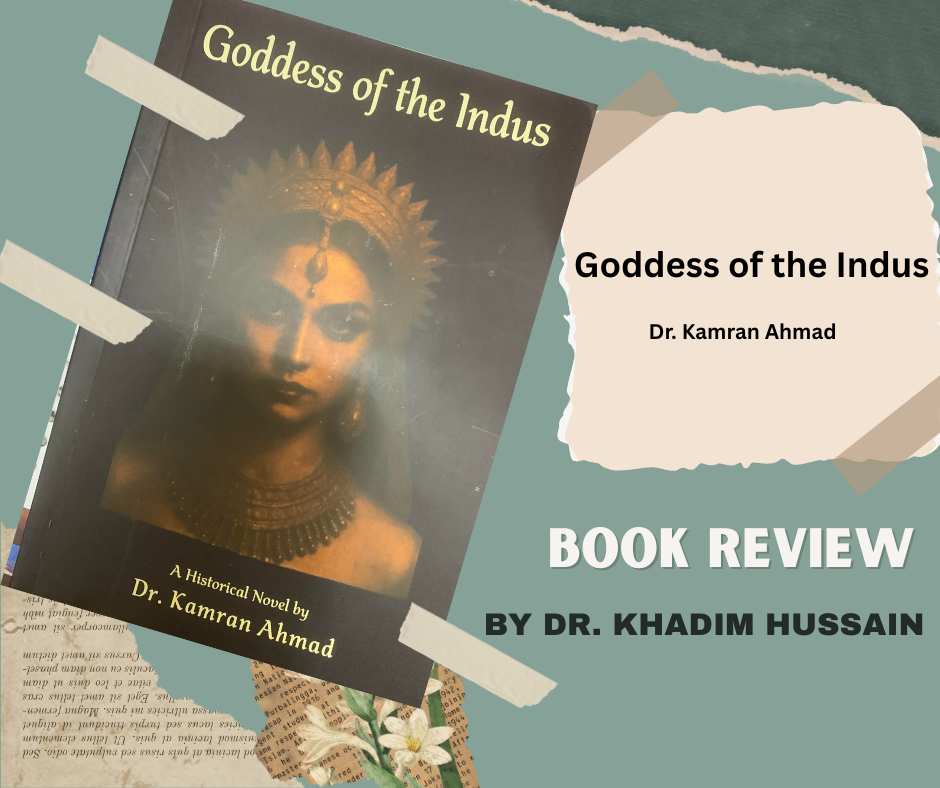
Goddess of the Indus is the one exquisite piece of great fictional art that I would like to suggest without any hesitation to anybody who wishes to discover deep rooted urge of collective identity running in the inner recesses of the unconscious for thousands of years in the South Asian regions, and to those who could dare to confront personal psychological inhibitions and suppressed pangs, regrets, guilt, desires and longings concealed in the inner chambers of heart. The novel by Dr. Kamran Ahmad has been published just recently by TWS Publications, Pakistan. The creative work exhibits rare creativity of heart touching themes and unusual skills of a great art.
Kamran Ahmad knows how to capture attention of readers till the end of the story through weaving events into a highly suspenseful story, using the symbols of Ambikshala and the Outlands skillfully—the former indicates the spirit while the latter demonstrates hierarchical structures of inflexible religious faiths and rigid social order. Set in the ancient Indian sub-continent when the fair-coloured Aryans had just climbed down from the mountains of Pamirs and Caucasus to the plains of the Indus Valley, the story of the novel carries seamless progression of events that rarely allows the reader to lose interest in the story and characters of the story. Dialectics of the physical world and internal frictions in the psychological depths of the characters of the novel do not only take the events forward to make a continuous flow of the plot of the novel but they also create a cathartic impact on the readers. Here is not just a story but a soft, sweet and soulful song of an artist that transcends the reader to an unseen world, an ancient world that resides in the unconscious, healing and resolving the inner wounds and conflicts of the reader on the way.
The novel explores unusual themes, mostly left untouched by scholars and artists, with unprecedented courage and confidence unpacking the origin of construction of the caste system in the Indus Valley. The invading Aryan hordes after subjugating the indigenous communities living with their indigenous life style that was largely in consonance with nature constructed a rigid, inflexible and hierarchical social and religious structure that distorted and polluted the life style of the indigenous communities. A wise Brahmin character of the novel, Indra, reveals that “this system serves to elevate the Arya—the Kshatriya and us (Brahmin)—into position of power and privilege and to subjugate the locals”. The superiority of the Arya was mostly justified through the skin colour—the fair-coloured Aryas as opposed to the dark-coloured indigenous people.
The other unusual theme that Kamran Ahmad treats with unwavering tenacity in the novel is the construction related to women’s bodies. When Gyani Baba (Simurgan), Syam and Jaavan were forced out of Ambikshala by circumstances, they had to face an unsettling reality that sexuality was considered dirty and shameful in the Outlands against the notion prevalent in Ambikshala where sexuality was considered sacred because it was a union of body and soul and was not used to control and manipulate others. In the words of Syam’s friend in the Outlands, Menaka “sexuality was always dirty and ugly for me. That is how it started for me. That is how it remained. And that is how I heard everybody talk about it…about sexuality as something dirty, as something to be ashamed of”.
Kamran Ahmad has dissected construction of the attachment of ‘shame’ and ‘honour’ to women bodies like a skilled surgeon with a sharp razor. The protagonist of the novel, Syam, sitting in the space created by Gyani Baba (Syam’s father) asserts: “as for connecting women bodies and their sexuality to honour and respect, I feel they are not real…notions of honour and respect are there to control women’s bodies and their sexuality”. “And to control their reproduction”, Gyani added. Explaining the phenomenon, Menaka reflects: “I always wonder about this obsession men in these lands have with their bloodlines and wanting to know that their children are really their children. Perhaps that is why they get the priests involved in marriage, sanctifying sex, which would otherwise remain an unholy and dirty affair”. With a gentle smile and distant look, she added, “with respect and honour connected to our bodies, our sexuality, and our reproduction, they do not have to guard us. We guard their bloodlines for them.” She laughed in a bitter sweet way”. The novel convincingly brings to light the guilt and regret caused by these notions and transformation of guilt and regret into virility of life expressed through arts like painting, music, dancing trance and poetry.
One of the highly significant and worth noting theme that Kamran Ahmad has dealt with in the novel is the conceptualisation of living in consonance with nature to create an earthly balance in contrast to hurting nature through the rigid, inflexible and hierarchical structure encompassed in texts and scriptures and justified through transcendental notions. Human agency to retore the balance has been underscored by rejecting the notion that exhorts “pull no threads, stir no pots”. The logical justification for the inflexible religiosity to bring “order” and stem “disorder” has been discerned to have been emanated from a lack of trust in human rationality and contemplative capacity.
Kamran Ahmad’s characters grow and evolve through their experiences of the dialectics of material world and through their individual psychological frictions, traumas and upheavals. The emotional and rational being of the protagonist, Syam, has been shaped by his mother Mehrani’s (mother goddess) closure to everything related to human connectivity, death of his son Pania and wife Matinga, and increasingly degenerating nature of the spirit of Ambikshala’s community life into rigid religiosity enshrined in scriptures and History Scroll. Mehrani, in turn, had been forced to close herself to nature due to her apparent guilt after rejecting Simurgan’s intense love and after silently disowning her son, Syam. Creative description of transformation of Mehrani, Menaka and Kamala in the novel after resolving their internal conflicts into authentic human personalities carries immense value of healing for the readers of the novel. Kamran Ahmad has, in this case, used his unique talent of a clinical psychologist to help mend broken and shattered personalities. He seems to have used the character of Shehrani (Sher Ma) as a tool for utilising his own spiritual and psychological qualities in this regard.
Kamran Ahmad’s heart-pounding and nail-biting story that suspends disbelief, his well-crafted plot, his round characterisation, his treatment of unusual and exotic themes, and his candid style and diction all have made Goddess of the Indus a must read for students and scholars of literature and social sciences.
(The writer is author, analyst and researcher based in Islamabad. He can be accessed at khadimhussainpajwak@gmail.com)