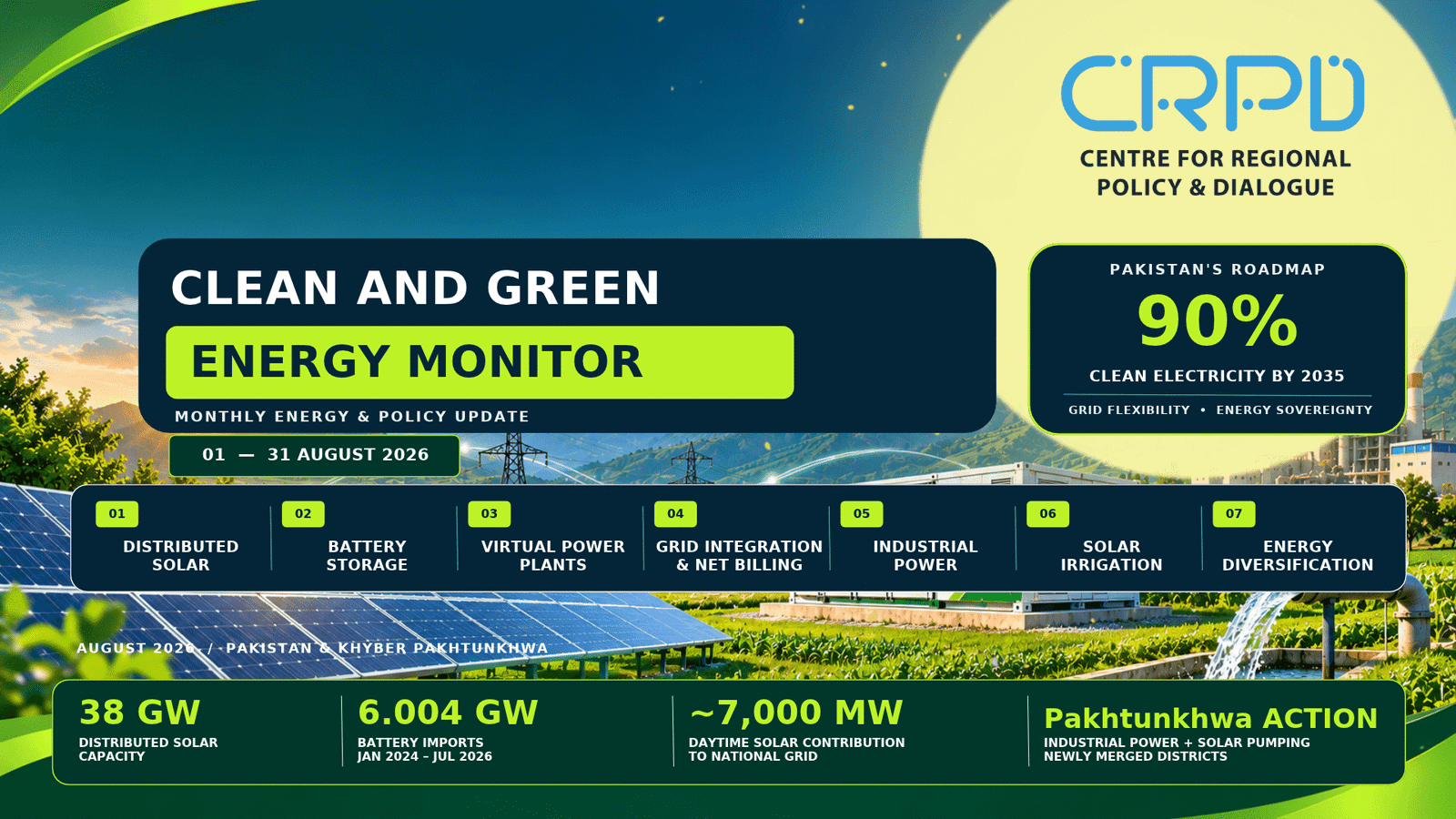
1. Pakistan announces a roadmap for 90% clean electricity by 2035
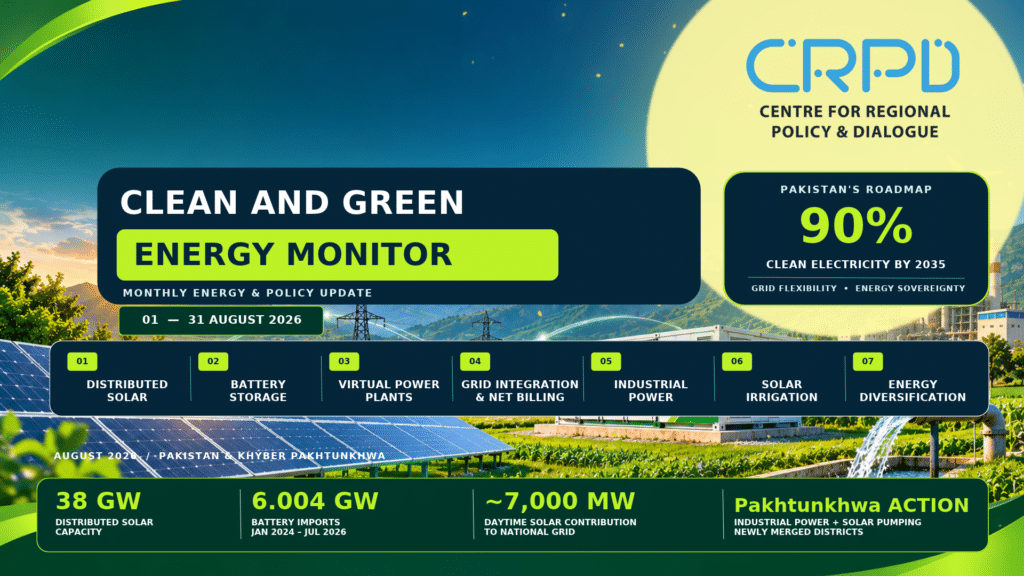
The federal power minister announced a roadmap to raise clean electricity to 90% of Pakistan’s power mix by 2035 at the Solar, Storage and Flexibility 2026 Conference. The announcement emphasized grid flexibility, energy sovereignty and domestic industry alongside the expansion of rooftop solar. The minister also highlighted the scale of consumer-led solar adoption, reporting approximately 38 GW of distributed solar capacity.
Source: Govt unveils plan for 90% clean electricity.
2. Battery storage investment grows as consumers move away from grid dependence
A report on Pakistan’s battery market described rising adoption of storage systems as consumers increasingly store surplus solar electricity for evening use instead of exporting it to the grid. It reported that battery imports reached a combined capacity of approximately 6.004 GW between January 2024 and July 2026, with 652.2 MW imported in April 2026. The report attributed the trend to high electricity tariffs, policy uncertainty and declining battery prices.
Source: Battery storage surges in Pakistan as consumers move away from national grid.
3. Distributed solar raises questions about integration with the central grid
An analysis of Pakistan’s solar expansion argued that the next challenge is not simply the price paid for surplus electricity, but how large volumes of distributed generation can be integrated into a centrally planned power system. As consumers generate more of their own electricity, demand patterns, grid use and the economics of conventional power supply change.
Source: When distributed solar meets a centralised power system.
4. Research examines the implications of Pakistan’s shift from net metering to net billing
Research discussed in pv magazine examined Pakistan’s move from the earlier net-metering regime to net billing, under which the compensation for surplus electricity exported to the grid was reduced. The analysis argued that the reform may address some financial pressures in the power sector, but cannot resolve deeper structural problems on its own.
Source: Pakistan’s net billing reform sheds light on deeper power sector issues.
5. Battery storage and virtual power plants gain attention
In an analysis of emerging storage opportunities, Dawn reported that Pakistan’s battery imports rose from 1.43 GWh in 2024 to 4.59 GWh in 2025, worth around US$36 million. The article explained how batteries can store daytime solar generation for evening consumption. It also discussed the potential for virtual power plants (VPPs), in which many household and small-business batteries can collectively provide flexibility to the power system.
6. Parliamentarians call for more flexible energy-import commitments amid solar growth
At a policy dialogue titled The Sun and the Pipeline: Energy Contracts in an Era of Solar Disruption in Pakistan, parliamentarians and energy experts urged the government to avoid inflexible long-term energy contracts that could expose Pakistan to costly take-or-pay obligations and worsen circular debt. Discussions addressed changing RLNG demand, global market volatility and the need for more flexible fuel-import planning as solar adoption expands.
Source: Parliamentarians urge government to avoid long-term energy contracts.
7. Khyber Pakhtunkhwa establishes a working group to address electricity problems in industrial zones
12 August 2026 · Directorate General of Information and Public Relations, Khyber Pakhtunkhwa
The provincial government announced the establishment of a high-level working group to address electricity supply problems in industrial zones and support investment. The group included provincial energy officials, PEDO, the Khyber Pakhtunkhwa Transmission and Grid System Company, PESCO, HAZECO, TESCO, the provincial economic-zones company and industrial-sector representatives. It was tasked with developing feasible proposals for more reliable electricity supply.
Source: Revolutionary measures took KP government to improve power supply to industries.
8. Solar pumping systems advertised for agricultural tube wells in Khyber Pakhtunkhwa’s newly merged districts
A procurement notice invited bids for a framework contract to procure and install solar pumping systems on existing agricultural tube wells and open wells under the scheme for cultivable wasteland development and solarization of existing agricultural wells in Khyber Pakhtunkhwa’s newly merged districts. The notice specified a single-stage, two-envelope bidding procedure.
Source: Invitation for Bids — Solar Pumping Systems in Khyber Pakhtunkhwa.
9. Procurement notice published for a 160-kW hybrid solar photovoltaic system
An EPADS procurement listing published a contract form for the supply, installation, testing and commissioning of a 160-kW hybrid solar photovoltaic system. The notice provides evidence of a specific solar procurement activity during the month; however, the listing alone does not establish the installation location, final award or commissioning status.
Source: EPADS procurement notice — 160 kW hybrid solar PV system.
10. Expensive RLNG-based generation highlights the economic case for energy diversification
Dawn reported that the cost of RLNG-based electricity generation rose to Rs47.4 per unit in July 2026, compared with less than Rs14 per unit in April. The increase was attributed largely to expensive spot-market cargoes following disruptions to Qatari supplies amid the US–Iran conflict. The report also highlighted the comparatively low fuel cost of domestic gas and other generation sources.
Source: Unusual RLNG price drives up electricity cost.
11. Daytime solar generation offers partial relief during electricity shortfalls
Reporting on power shortages in Punjab, The Express Tribune noted that the electricity shortfall was relatively lower during daytime hours because of solar generation. The article cited sources estimating that solar contributed around 7,000 MW to the national grid daily. The report also described reduced generation and delays in RLNG deliveries as factors contributing to supply constraints.